Advertisements
Advertisements
प्रश्न
What is Reynold’s number? Give its significance.
Advertisements
उत्तर
It is a dimensionless number that determines the nature of the flow of fluid through a pipe. Reynold’s number is given by,
Rc = `(ρ"vD")/"η"`
If, Rc < 1000 - Streamline
1000 < Rc < 2000 - Unsteady
Rc > 2000 - Turbulent
APPEARS IN
संबंधित प्रश्न
The force of viscosity is
The viscous force acting between two layers of a liquid is given by \[\frac{F}{A} = - \eta\frac{dv}{dz}\]. This F/A may be called
A spherical ball is dropped in a long column of a viscous liquid. The speed of the ball as a function of time may be best represented by the graph
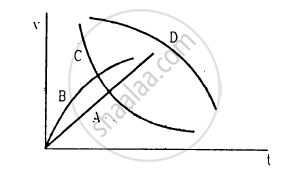
Write down the expression for Stoke’s force and explain the symbols involved in it.
The tangential force or viscous drag on any layer of the liquid is directly proportional to the velocity gradient `"dv"/"dx"`. Then the direction of dx velocity gradient is ____________.
The velocity of a small ball of mass M and density d, when dropped in a container filled with glycerine becomes constant after some time. If the density of glycerine is `"d"/2`, then the viscous force acting on the ball will be ______
A solid ball of density ρ1 and radius r falls vertically through a liquid of density ρ2. Assume that the viscous force acting on the ball is F = krv, where k is a constant and v its velocity. What is the terminal velocity of the ball?
A liquid of density ρ and coefficient of viscosity η flows with velocity v through a tube of diameter D. A quantity `"R" = (rho"vD")/η`, determines whether the flow will be streamlined or turbulent. R has the dimension of ______.
The dimensions of coefficient of viscosity are ______.
A water pipe with diameter of 5.0 cm is connected to another pipe of diameter 2.5 cm. How would the speeds of the water flow compare?
