Advertisements
Advertisements
प्रश्न
In Millikan’s oil drop experiment, what is the terminal speed of an uncharged drop of radius 2.0 × 10⁻⁵ m and density 1.2 × 10³ kg m–3? Take the viscosity of air at the temperature of the experiment to be 1.8 × 10⁻⁵ Pa s. How much is the viscous force on the drop at that speed? Neglect buoyancy of the drop due to air.
Advertisements
उत्तर १
Terminal speed = 5.8 cm/s; Viscous force = 3.9 × 10⁻¹⁰ N
Radius of the given uncharged drop, r = 2.0 × 10⁻⁵ m
Density of the uncharged drop, ρ = 1.2 × 10³ kg m–3
Viscosity of air, `eta = 1.8 xx 10^(-5) Pa s`
Density of air (`rho_0`) can be taken as zero in order to neglect buoyancy of air.
Acceleration due to gravity, g = 9.8 m/s2
Terminal velocity (v) is given by the relation:
`v = (2r^2 xx (rho - rho_0)g)/(9eta)`
`= (2xx(2.0xx10^(-5))^2 (1.2xx10^3 - 0)xx 9.8)/(9xx1.8xx10^(-5))`
`= 5.807 xx10^(-2) ms^(-1)`
`= 5.8 cm^1`
Hence, the terminal speed of the drop is 5.8 cm s–1.
The viscous force on the drop is given by:
`F = 6pietarv`
`:. F = 6xx3.14xx1.8xx10^(-5)xx2.0xx^(-5)xx 5.8xx10^(-2)`
`= 3.9 xx 10^(-10) N`
Hence, the viscous force on the drop is 3.9 × 10⁻¹⁰ N.
उत्तर २
Here radius of drop, r = 2.0 x 10⁻⁵ m, density of drop, p = 1.2 x 10³ kg/m3, viscosity of air TI = 1.8 x 10⁻⁵Pa-s.
Neglecting upward thrust due to air, we find that terminal speed is
`v_r = 2/9 (r62rhog)/eta = (2xx(2.0xx10^(-5))^2xx(1.2xx10^3))xx9.8)/(9xx(1.8xx10^(-5)))`
`= 5.81 xx 10^(-2) ms^(-1) " or " 5.81 cm s^(-1)`
Viscous force at this speed
`F = 6pietarv = 6 xx 3.14 xx (1.8xx10^(-5))xx (2.0xx10^(-5))xx (5.81xx10^(-2))`
`= 3.94 xx 10^(10) N`
APPEARS IN
संबंधित प्रश्न
Explain why The size of the needle of a syringe controls flow rate better than the thumb pressure exerted by a doctor while administering an injection
The force of viscosity is
A raindrop falls near the surface of the earth with almost uniform velocity because
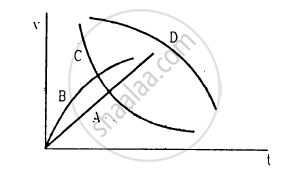
A spherical ball is dropped in a long column of a viscous liquid. The speed of the ball as a function of time may be best represented by the graph
Estimate the speed of vertically falling raindrops from the following data. Radius of the drops = 0.02 cm, viscosity of air = 1.8 × 10⁻⁴ poise, g= 9.9 × 10 ms−2 and density of water = 1000 kg m−3.
Water flows at a speed of 6 cm s−1 through a tube of radius 1 cm. Coefficient of viscosity of water at room temperature is 0.01 poise. Calculate the Reynolds number. Is it a steady flow?
Which has greater viscosity, oil or honey? Why?
A small sphere of radius 2 cm falls from rest in a viscous liquid. Heat is produced due to viscous force. The rate of production of heat when the sphere attains its terminal velocity is proportional to
In a horizontal pipe of non-uniform cross-section, water flows with a velocity of 1 ms−1 at a point where the diameter of the pipe is 20 cm. The velocity of water (1.5 ms−1) at a point where the diameter of the pipe is (in cm)
Define the coefficient of viscosity of a liquid.
Distinguish between streamlined flow and turbulent flow.
Define terminal velocity.
Write down the expression for Stoke’s force and explain the symbols involved in it.
Choose the CORRECT statement.
With increase in temperature, the viscosity of ______.
- gases decreases.
- liquids increases.
- gases increases.
- liquids decreases.
The velocity of a small ball of mass 0.3 g and density 8 g/cc when dropped in a container filled with glycerine becomes constant after some time. If the density of glycerine is 1.3 g/cc, then the value of viscous force acting on the ball will be x × 10-4 N, and the value of x is ______.
[use g = 10 m/s2]
A spherical solid ball of volume V is made of a material of density ρ1. It is falling through a liquid of density ρ2 (ρ2 < ρ1). Assume that the liquid applies a viscous force on the ball that is proportional to the square of its speed v, i.e., `"F"_"viscous"`= -kv2 (k > 0). The terminal speed of the ball is ______.
State and explain Newton's law of viscosity.
