Advertisements
Advertisements
Question
Two streamlines cannot cross each other. Why?
Advertisements
Solution
If two streamlines cross each other, there will be two directions of flow at the point of intersection which is impossible.
APPEARS IN
RELATED QUESTIONS
Fill in the blanks using the word(s) from the list appended with each statement
For solids with elastic modulus of rigidity, the shearing force is proportional to . . . , while for fluids it is proportional to . .. (shear strain / rate of shear strain)
The viscous force acting between two layers of a liquid is given by \[\frac{F}{A} = - \eta\frac{dv}{dz}\]. This F/A may be called
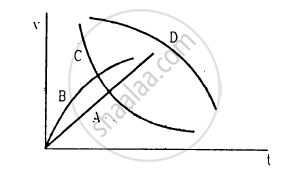
A spherical ball is dropped in a long column of a viscous liquid. The speed of the ball as a function of time may be best represented by the graph
What is Reynold’s number? Give its significance.
Why two holes are made to empty an oil tin?
An incompressible liquid flows through a unifonn cross sectional tube with velocity 20 cm/s. If the thickness of liquid layer is 0.8 cm then velocity of gradient of flow is ____________.
Choose the CORRECT statement.
The velocity of a small ball of mass M and density d, when dropped in a container filled with glycerine becomes constant after some time. If the density of glycerine is `"d"/2`, then the viscous force acting on the ball will be ______
Is viscosity a vector?
A water pipe with diameter of 5.0 cm is connected to another pipe of diameter 2.5 cm. How would the speeds of the water flow compare?
