Advertisements
Advertisements
प्रश्न
A metal sphere of radius 1 mm and mass 50 mg falls vertically in glycerine. Find (a) the viscous force exerted by the glycerine on the sphere when the speed of the sphere is 1 cm s−1, (b) the hydrostatic force exerted by the glycerine on the sphere and (c) the terminal velocity with which the sphere will move down without acceleration. Density of glycerine = 1260 kg m−3 and its coefficient of viscosity at room temperature = 8.0 poise.
Advertisements
उत्तर
Given:
Radius of metallic sphere r = 1 mm = 10−3 m
Speed of the sphere v = 10−2 m/s
Coefficient of viscosity η = 8 poise = 0.8 decapoise
Mass m = 50 mg = 50 × 10−3 kg
Density of glycerin σ = 1260 kg/m3
(a) Viscous force exerted by glycerine on the sphere F = 6πηrv
⇒ F= 6 × (3.14) × (0.8) × 10−3 × (10−2)
= 1.50 × 10⁻⁴ N
(b) Let V be the volume of the sphere.
Hydrostatic force exerted by glycerin on the sphere
\[F' = V\sigma g\]
\[\Rightarrow F' = \frac{4}{3}\pi r^2 \sigma g\]
\[= \left( \frac{4}{3} \right) \times \left( 3 . 14 \right) \times \left( {10}^{- 6} \right) \times 1260 \times 10\]
\[ = 5 . 275 \times {10}^{- 5} \text{N}\]
(c) Let the terminal velocity of the sphere be v'.
The forces acting on the drops are
(i) The weight mg acting downwards
(ii) The force of buoyance, i.e., \[\frac{4}{3}\pi r^3 \sigma g\] acting upwards
(iii) The force of viscosity, i.e., 6πηrv' acting upwards
From the free body diagram:
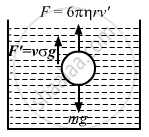
\[6\pi\eta r v' + \frac{4}{3}\pi r^3 \sigma g = \text{ mg}\]
\[ \Rightarrow v = \frac{\text{ mg }- \frac{4}{3}\pi r^2 \sigma g}{6\pi\eta r}\]
\[ = \frac{50 \times {10}^{- 3} - \frac{4}{3} \times 3 . 14 \times {10}^{- 6} \times 1260 \times 10}{6 \times 3 . 14 \times 0 . 8 \times {10}^{- 3}}\]
\[ = \frac{500 - \frac{4}{3} \times 3 . 14 \times {10}^{- 3} \times 1260 \times 10}{6 \times 3 . 14 \times 0 . 8}\]
\[ = 2 . 3 \text{ cm/s }\]
APPEARS IN
संबंधित प्रश्न
Fill in the blanks using the word(s) from the list appended with each statement
Viscosity of gases. .. with temperature, whereas viscosity of liquids . . . with temperature (increases / decreases)
Fill in the blanks using the word(s) from the list appended with each statement
For solids with elastic modulus of rigidity, the shearing force is proportional to . . . , while for fluids it is proportional to . .. (shear strain / rate of shear strain)
The force of viscosity is
The viscous force acting between two layers of a liquid is given by \[\frac{F}{A} = - \eta\frac{dv}{dz}\]. This F/A may be called
Estimate the speed of vertically falling raindrops from the following data. Radius of the drops = 0.02 cm, viscosity of air = 1.8 × 10⁻⁴ poise, g= 9.9 × 10 ms−2 and density of water = 1000 kg m−3.
A small sphere of radius 2 cm falls from rest in a viscous liquid. Heat is produced due to viscous force. The rate of production of heat when the sphere attains its terminal velocity is proportional to
In a horizontal pipe of non-uniform cross-section, water flows with a velocity of 1 ms−1 at a point where the diameter of the pipe is 20 cm. The velocity of water (1.5 ms−1) at a point where the diameter of the pipe is (in cm)
Define terminal velocity.
Write down the expression for Stoke’s force and explain the symbols involved in it.
Two streamlines cannot cross each other. Why?
An incompressible liquid flows through a unifonn cross sectional tube with velocity 20 cm/s. If the thickness of liquid layer is 0.8 cm then velocity of gradient of flow is ____________.
From amongst the following curves, which one shows the variation of the velocity v with time t for a small-sized spherical body falling vertically in a long column of a viscous liquid.
In motors, more viscous oil is used in summer than in winter due to ____________.
A spherical solid ball of volume V is made of a material of density ρ1. It is falling through a liquid of density ρ2 (ρ2 < ρ1). Assume that the liquid applies a viscous force on the ball that is proportional to the square of its speed v, i.e., `"F"_"viscous"`= -kv2 (k > 0). The terminal speed of the ball is ______.
Define velocity gradient.
A water pipe with diameter of 5.0 cm is connected to another pipe of diameter 2.5 cm. How would the speeds of the water flow compare?
