Advertisements
Advertisements
प्रश्न
Estimate the speed of vertically falling raindrops from the following data. Radius of the drops = 0.02 cm, viscosity of air = 1.8 × 10⁻⁴ poise, g= 9.9 × 10 ms−2 and density of water = 1000 kg m−3.
Advertisements
उत्तर
Given:
Radius of the drops r = 0.02 cm = 2 × 10⁻⁴ m
Viscosity of air η = 1.8 × 10⁻⁴ poise = 1.8 × 10⁻⁵ decapoise
Acceleration due to gravity g = 9.9 m/s2
Density of water ρ = 1000 kg/m3
Let v be the terminal velocity of a drop.
The forces acting on the drops are
(i) The weight mg acting downwards
(ii) The force of buoyance, i.e., \[\left( \frac{4}{3} \right) \pi r^3 \rho g\] acting upwards
(iii) The force of viscosity, i.e., 6πηrv acting upwards
Because the density of air is very small, the force of buoyance can be neglected.
From the free body diagram:
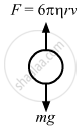
\[6\pi\eta \text{ rv = mg }\]
\[6\pi\eta rv = \frac{4}{3}\pi r^3 \rho g\]
\[v = 2 r^2 \frac{\rho g}{9\eta}\]
\[= 2 \times \left( 0 . 02 \times {10}^{- 2} \right)^2 \times 1000 \times \frac{\left( 9 . 9 \right)}{9} \times \left( 1 . 8 \times {10}^{- 5} \right)\]
\[ = 5 \text{ m/s }.\]
Hence, the required vertical speed of the falling raindrops is 5 m/s.
APPEARS IN
संबंधित प्रश्न
Explain why The size of the needle of a syringe controls flow rate better than the thumb pressure exerted by a doctor while administering an injection
In Millikan’s oil drop experiment, what is the terminal speed of an uncharged drop of radius 2.0 × 10⁻⁵ m and density 1.2 × 10³ kg m–3? Take the viscosity of air at the temperature of the experiment to be 1.8 × 10⁻⁵ Pa s. How much is the viscous force on the drop at that speed? Neglect buoyancy of the drop due to air.
The viscous force acting between two layers of a liquid is given by \[\frac{F}{A} = - \eta\frac{dv}{dz}\]. This F/A may be called
The unit of viscosity is
Which has greater viscosity, oil or honey? Why?
A small sphere of radius 2 cm falls from rest in a viscous liquid. Heat is produced due to viscous force. The rate of production of heat when the sphere attains its terminal velocity is proportional to
With an increase in temperature, the viscosity of liquid and gas, respectively will __________.
Define the coefficient of viscosity of a liquid.
Define terminal velocity.
Write down the expression for Stoke’s force and explain the symbols involved in it.
Derive Poiseuille’s formula for the volume of a liquid flowing per second through a pipe under streamlined flow.
A small metal sphere of mass M and density d1, when dropped in a jar filled with liquid moves with terminal velocity after sometime. The viscous force acting on the sphere is (d2 = density of liquid and g = gravitational acceleration)
From amongst the following curves, which one shows the variation of the velocity v with time t for a small-sized spherical body falling vertically in a long column of a viscous liquid.
The velocity of a small ball of mass M and density d, when dropped in a container filled with glycerine becomes constant after some time. If the density of glycerine is `"d"/2`, then the viscous force acting on the ball will be ______
The coefficient of apparent expansion of mercury in a glass vessel is 153 × 10-6/°C and in a steel vessel is 144 × 10-6/°C. If α for steel is 12 × 10-6/°C, then that of glass is ______.
Define the coefficient of viscosity.
A force of 0.01 N is required to move a flat glass plate of area of 10 cm2 with a uniform velocity of 1 cm/ s over the surface of a liquid 2 mm thick. If the coefficient of viscosity of the liquid is 20 poise, the velocity gradient in the liquid layer is ______.
The dimensions of coefficient of viscosity are ______.
