Advertisements
Advertisements
प्रश्न
Define the coefficient of viscosity.
Advertisements
उत्तर
The coefficient of viscosity is defined as the viscous force per unit area per unit velocity gradient.
APPEARS IN
संबंधित प्रश्न
Fill in the blanks using the word(s) from the list appended with each statement
For solids with elastic modulus of rigidity, the shearing force is proportional to . . . , while for fluids it is proportional to . .. (shear strain / rate of shear strain)
The viscous force acting between two layers of a liquid is given by \[\frac{F}{A} = - \eta\frac{dv}{dz}\]. This F/A may be called
A raindrop falls near the surface of the earth with almost uniform velocity because
A spherical ball is dropped in a long column of a viscous liquid. The speed of the ball as a function of time may be best represented by the graph
Estimate the speed of vertically falling raindrops from the following data. Radius of the drops = 0.02 cm, viscosity of air = 1.8 × 10⁻⁴ poise, g= 9.9 × 10 ms−2 and density of water = 1000 kg m−3.
The unit of viscosity is
Which has greater viscosity, oil or honey? Why?
Define the coefficient of viscosity of a liquid.
Distinguish between streamlined flow and turbulent flow.
Define terminal velocity.
Write down the expression for Stoke’s force and explain the symbols involved in it.
Derive the expression for the terminal velocity of a sphere moving in a high viscous fluid using stokes force.
Derive Poiseuille’s formula for the volume of a liquid flowing per second through a pipe under streamlined flow.
A block of Ag of mass x kg hanging from a string is immersed in a liquid of relative density 0.72. If the relative density of Ag is 10 and tension in the string is 37.12 N then compute the mass of Ag block.
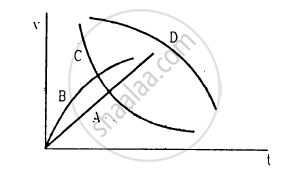
From amongst the following curves, which one shows the variation of the velocity v with time t for a small-sized spherical body falling vertically in a long column of a viscous liquid.
In motors, more viscous oil is used in summer than in winter due to ____________.
The velocity of water in river is 8 km/hr of the upper surface. The river is 12 m deep. If the coefficient of viscosity of water is 10-2 poise then the shearing stress between horizontal layers of water is ______.
The velocity of a small ball of mass M and density d, when dropped in a container filled with glycerine becomes constant after some time. If the density of glycerine is `"d"/2` , then the viscous force acting on the ball will be ______.
With increase in temperature, the viscosity of ______.
- gases decreases.
- liquids increases.
- gases increases.
- liquids decreases.
Is viscosity a vector?
A solid ball of density ρ1 and radius r falls vertically through a liquid of density ρ2. Assume that the viscous force acting on the ball is F = krv, where k is a constant and v its velocity. What is the terminal velocity of the ball?
The velocity of a small ball of mass 0.3 g and density 8 g/cc when dropped in a container filled with glycerine becomes constant after some time. If the density of glycerine is 1.3 g/cc, then the value of viscous force acting on the ball will be x × 10-4 N, and the value of x is ______.
[use g = 10 m/s2]
An air bubble of negligible weight having radius r rises steadily through a solution of density σ at speed v. The coefficient of viscosity of the solution is given by ______.
A spherical solid ball of volume V is made of a material of density ρ1. It is falling through a liquid of density ρ2 (ρ2 < ρ1). Assume that the liquid applies a viscous force on the ball that is proportional to the square of its speed v, i.e., `"F"_"viscous"`= -kv2 (k > 0). The terminal speed of the ball is ______.
State the formula and S.I. units of coefficient of viscosity.
A water pipe with diameter of 5.0 cm is connected to another pipe of diameter 2.5 cm. How would the speeds of the water flow compare?
