Advertisements
Advertisements
प्रश्न
A water pipe with diameter of 5.0 cm is connected to another pipe of diameter 2.5 cm. How would the speeds of the water flow compare?
Advertisements
उत्तर
d1 = 5 cm = d2 = 2 .5 cm
∵ A1 v1 = A2 v2
∴ `v_1/v_2 = A_2/A_1 = (pir_2^2)/ (pi r_1^2)`
`= ((d_2//2) /( d_1//2))^2 = (d_2/d_1)^2`
∴ `v_1/v_2 = (2.5/5)^2`
`= (1/2)^2`
`= 1/4`
APPEARS IN
संबंधित प्रश्न
Fill in the blanks using the word(s) from the list appended with each statement
Viscosity of gases. .. with temperature, whereas viscosity of liquids . . . with temperature (increases / decreases)
Fill in the blanks using the word(s) from the list appended with each statement
For solids with elastic modulus of rigidity, the shearing force is proportional to . . . , while for fluids it is proportional to . .. (shear strain / rate of shear strain)
The force of viscosity is
A raindrop falls near the surface of the earth with almost uniform velocity because
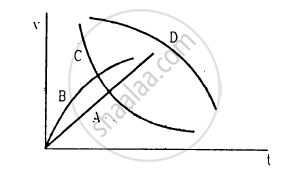
A spherical ball is dropped in a long column of a viscous liquid. The speed of the ball as a function of time may be best represented by the graph
Estimate the speed of vertically falling raindrops from the following data. Radius of the drops = 0.02 cm, viscosity of air = 1.8 × 10⁻⁴ poise, g= 9.9 × 10 ms−2 and density of water = 1000 kg m−3.
Water flows at a speed of 6 cm s−1 through a tube of radius 1 cm. Coefficient of viscosity of water at room temperature is 0.01 poise. Calculate the Reynolds number. Is it a steady flow?
The unit of viscosity is
Write down the expression for Stoke’s force and explain the symbols involved in it.
Two streamlines cannot cross each other. Why?
Why two holes are made to empty an oil tin?
A small metal sphere of mass M and density d1, when dropped in a jar filled with liquid moves with terminal velocity after sometime. The viscous force acting on the sphere is (d2 = density of liquid and g = gravitational acceleration)
Choose the CORRECT statement.
In motors, more viscous oil is used in summer than in winter due to ____________.
The velocity of water in river is 8 km/hr of the upper surface. The river is 12 m deep. If the coefficient of viscosity of water is 10-2 poise then the shearing stress between horizontal layers of water is ______.
The velocity of a small ball of mass M and density d, when dropped in a container filled with glycerine becomes constant after some time. If the density of glycerine is `"d"/2` , then the viscous force acting on the ball will be ______.
With increase in temperature, the viscosity of ______.
- gases decreases.
- liquids increases.
- gases increases.
- liquids decreases.
A solid ball of density ρ1 and radius r falls vertically through a liquid of density ρ2. Assume that the viscous force acting on the ball is F = krv, where k is a constant and v its velocity. What is the terminal velocity of the ball?
An air bubble of negligible weight having radius r rises steadily through a solution of density σ at speed v. The coefficient of viscosity of the solution is given by ______.
A liquid of density ρ and coefficient of viscosity η flows with velocity v through a tube of diameter D. A quantity `"R" = (rho"vD")/η`, determines whether the flow will be streamlined or turbulent. R has the dimension of ______.
Define the coefficient of viscosity.
State the formula and S.I. units of coefficient of viscosity.
State and explain Newton's law of viscosity.
The dimensions of coefficient of viscosity are ______.
