Advertisements
Advertisements
Question
A wire can sustain the weight of 20 kg before breaking. If the wire is cut into two equal parts, each part can sustain a weight of
Options
10 kg
20 kg
40 kg
80 kg
Advertisements
Solution
As the wire is cut into two equal parts, both have equal cross-sectional areas. Therefore, a weight of 20 kg exerts a force of 20g on both the pieces. Breaking stress depends upon the material of the wire. Since 20g of force is exerted on wires with equal cross-sectional areas, both the wires can sustain a weight of 20 kg.
APPEARS IN
RELATED QUESTIONS
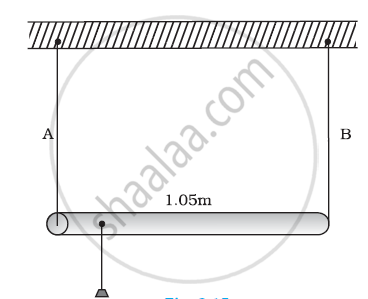
A rod of length 1.05 m having negligible mass is supported at its ends by two wires of steel (wire A) and aluminium (wire B) of equal lengths as shown in Figure. The cross-sectional areas of wires A and B are 1.0 mm2 and 2.0 mm2, respectively. At what point along the rod should a mass m be suspended in order to produce (a) equal stresses and (b) equal strains in both steel and aluminium wires.
Two strips of metal are riveted together at their ends by four rivets, each of diameter 6.0 mm. What is the maximum tension that can be exerted by the riveted strip if the shearing stress on the rivet is not to exceed 6.9 × 10⁷ Pa? Assume that each rivet is to carry one-quarter of the load.
When a block a mass M is suspended by a long wire of length L, the elastic potential potential energy stored in the wire is `1/2` × stress × strain × volume. Show that it is equal to `1/2` Mgl, where l is the extension. The loss in gravitational potential energy of the mass earth system is Mgl. Where does the remaining `1/2` Mgl energy go ?
The yield point of a typical solid is about 1%. Suppose you are lying horizontally and two persons are pulling your hands and two persons are pulling your legs along your own length. How much will be the increase in your length if the strain is 1% ? Do you think your yield point is 1% or much less than that?
Answer in one sentence.
Define strain.
Answer in one sentence.
How should be a force applied on a body to produce shearing stress?
Modulus of rigidity of ideal liquids is ______.
The maximum load a wire can withstand without breaking, when its length is reduced to half of its original length, will ______.
A rectangular frame is to be suspended symmetrically by two strings of equal length on two supports (Figure). It can be done in one of the following three ways;
| (a) |  |
| (b) |  |
| (c) |  |
The tension in the strings will be ______.
A rod of length l and negligible mass is suspended at its two ends by two wires of steel (wire A) and aluminium (wire B) of equal lengths (Figure). The cross-sectional areas of wires A and B are 1.0 mm2 and 2.0 mm2, respectively.
(YAl = 70 × 109 Nm−2 and Ysteel = 200 × 109 Nm–2)

- Mass m should be suspended close to wire A to have equal stresses in both the wires.
- Mass m should be suspended close to B to have equal stresses in both the wires.
- Mass m should be suspended at the middle of the wires to have equal stresses in both the wires.
- Mass m should be suspended close to wire A to have equal strain in both wires.
Consider a long steel bar under a tensile stress due to forces F acting at the edges along the length of the bar (Figure). Consider a plane making an angle θ with the length. What are the tensile and shearing stresses on this plane

- For what angle is the tensile stress a maximum?
- For what angle is the shearing stress a maximum?
The value of tension in a long thin metal wire has been changed from T1 to T2. The lengths of the metal wire at two different values of tension T1 and T2 are l1 and l2 respectively. The actual length of the metal wire is ______.
A steel wire having a radius of 2.0 mm, carrying a load of 4 kg, is hanging from a ceiling. Given that g = 3.1πms-2, what will be the tensile stress that would be developed in the wire?
If 'S' is stress and 'Y' is young's modulus of the material of a wire, the energy stored in the wire per unit volume is ______.
What is an elastomer?
What is the physical quantity defined as the internal restoring force per unit area of a body?
The SI unit of stress is ______.
