Please select a subject first
Advertisements
Advertisements
When current flowing through a solenoid decreases from 5A to 0 in 20 milliseconds, an emf of 500V is induced in it.
- What is this phenomenon called?
- Calculate coefficient of self-inductance of the solenoid.
Concept: Ampere’s Circuital Law
The figure below shows a circuit containing an ammeter A, a galvanometer G and a plug key K. When the key is closed:

Concept: Moving Coil Galvanometer
A galvanometer of resistance 100 Ω gives a full-scale deflection for a potential difference of 200 mV.
- What must be the resistance connected to convert the galvanometer into an ammeter of the range 0-200 mA?
- Determine resistance of the ammeter.
Concept: Moving Coil Galvanometer
A rectangular loop of area 5m2, has 50 turns and carries a current of 1A. It is hold in a uniform magnetic field of 0.1T, at an angle of 30°. Calculate the torque experienced by the coil.
Concept: Torque on a Magnetic Dipole (Bar Magnet) in a Uniform Magnetic Field
Define Curie temperature.
Concept: Current Loop as a Magnetic Dipole : Magnetic Dipole Moment of Current Loop
If magnetic susceptibility of a certain magnetic material is 0 0001, find its relative permeability.
Concept: Current Loop as a Magnetic Dipole : Magnetic Dipole Moment of Current Loop
A rectangular coil having 60 turns and area of 0.4m2 is held at right angles to a uniform magnetic field of flux density 5 × 10⁻⁵T. Calculate the magnetic flux passing through it.
Concept: Magnetic Flux
An emf of 2V is induced in a coil when the current in it is changed from 0A to 10A in 0·40 sec. Find the coefficient of self-inductance of the coil.
Concept: Introduction to Electromagnetic Induction
A coil of self-inductance 2.5H and resistance 20Ω is connected to a battery of emf 120V having the internal resistance of 5 n. Find:
1) The time constant of the circuit.
2) The current in the circuit in steady state
Concept: Inductance >> Mutual Inductance
Calculate magnetic flux density of the magnetic field at the centre of a circular coil of 50 turns, having a radius of 0.5m and carrying a current of 5 A.
Concept: Magnetic Flux
A coil has a self-inductance of 0·05 Henry. Find the magnitude of the emf induced in it when the current flowing through it is changing at the rate of 100 As-1.
Concept: Introduction to Electromagnetic Induction
Find magnetic flux density at a point on the axis of a long solenoid having 5000 tums/m when it carrying a current of 2 A.
Concept: Magnetic Flux
A circular coil has radius ‘r', number of turns ‘N’ and carries a current ‘I’. Magnetic flux density ‘B’ at its centre is ______.
Concept: Magnetic Flux
When an electric current is passed through a wire or a coil, a magnetic field is produced. Is the reverse phenomenon possible i.e, can a magnetic field produce an electric current? Explain with the help of an appropriate example.
Concept: Introduction to Electromagnetic Induction
The Figure below shows an infinitely long metallic wire YY' which is carrying a current I'.
P is a point at a perpendicular distance r from it.
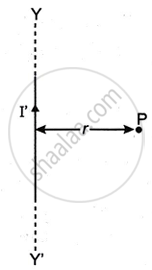
- What is the direction of magnetic flux density B of the magnetic field at the point P?
- What is the magnitude of magnetic flux density B of the magnetic field at the point P?
- Another metallic wire MN having length l and carrying a current I is now kept at point P. If the two wires are in vacuum and parallel to each other, how much force acts on the wire MN due to the current I' flowing in the wire YY'?
Concept: Magnetic Flux
A transformer is used to step up an alternating emf of 200V to 440V. If the primary coil has 1000 turns, calculate the number of turns in the secondary coil.
Concept: Transformers
An a.c generator generates an emf 'ε' where ε = 314 Sin (50πt) volt. Calculate the frequency of emf ε.
Concept: Transformers
What is the turns ratio i.e., transformer ratio, ns: np, in an ideal transformer which in-creases ac voltage from 220 V to 33000 V?
Concept: Transformers
In an ideal transformer, an output of 66 kV is required when an input voltage of 220 V is available. If the primary has 300 turns, how many turns should the secondary have?
Concept: Transformers
