Advertisements
Advertisements
Question
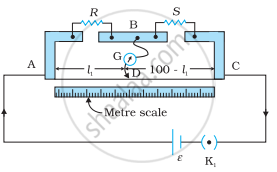
A meter bridge is balanced with a known resistance (R) in the left hand gap and an unknown resistance (S) in the right hand gap. Balance point is found to be at a distance of 1 cm from the left hand side. When the battery and the galvanometer are interchanged, balance point will ______.
Options
Shift towards left.
Shift towards right.
Remain same.
Shift towards left or right depending on the values of R and S.
Advertisements
Solution
A meter bridge is balanced with a known resistance (R) in the left hand gap and an unknown resistance (S) in the right hand gap. Balance point is found to be at a distance of 1 cm from the left hand side. When the battery and the galvanometer are interchanged, balance point will remain same.
Explanation:
The balance point remains constant even if the galvanometer and batteries are switched out.
APPEARS IN
RELATED QUESTIONS
In potentiometer experiment, if l1 is the balancing length for e.m.f. of cell of internal resistance r and l2 is the balancing length for its terminal potential difference when shunted with resistance R then :
The instrument which can measure terminal potential difference as well as electromotive force (e.m. f.) is ______
- Wheatstone’s meter bridge
- Voltmeter
- Potentiometer
- Galvanometer
Which material is used for the meter bridge wire and why?
(a) In a metre bridge [shown in the figure], the balance point is found to be at 39.5 cm from the end A, when the resistor Y is 12.5 Ω. Determine the resistance of X. Why are the connections between resistors in a Wheatstone or meter bridge made of thick copper strips?
(b) Determine the balance point of the bridge above if X and Y are interchanged.
(c) What happens if the galvanometer and cell are interchanged at the balance point of the bridge? Would the galvanometer show any current?
An I0m long uniform metallic wire having a resistance of 20Ω IS used as a potentiometer wire. This wire is connected in series with another resistance of 480Ω
and a battery of emf 5V having negligible internal resistance. If an unknown emf e is balanced across 6m of the potentiometer wire, calculate
1) the potential gradient across the potentiometer wire
2) the value of the unknown emf e.
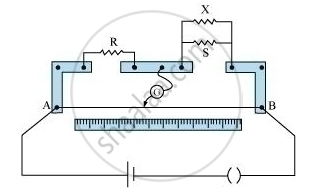
In a meter bridge, the null point is found at a distance of l1 cm from A. If now a resistance of X is connected in parallel with S, the null point occurs at l2 cm. Obtain a formula for X in terms of l1, l2 and S.
Two resistances are connected in the two gaps of a meter bridge. The balance points is 20 cm from the zero end. When resistance of 15 ohm is connected in series with the smaller of the two resistances, the null point shifts to 40 cm. The smaller of the two resistances has the value (in ohm) ______.
In a meter bridge, when galvanometer and cell positions are interchanged, ______.
When a metal conductor connected to left gap of a meter bridge is heated, the balancing point ______.
In a meter bridge experiment, resistance are connected as shown in figure, The balancing length 1, is 55 cm. Now an unknown resistance x is connected in series with P and new balancing length is found to be 75cm. The value of x is ______.

