Advertisements
Advertisements
Question
An I0m long uniform metallic wire having a resistance of 20Ω IS used as a potentiometer wire. This wire is connected in series with another resistance of 480Ω
and a battery of emf 5V having negligible internal resistance. If an unknown emf e is balanced across 6m of the potentiometer wire, calculate
1) the potential gradient across the potentiometer wire
2) the value of the unknown emf e.
Advertisements
Solution
`l_1 = 10 m`
R = 20 Ω
`R_1 = 480 Ω`
V = 5 V
balancing lenght = `l_2 = 6m`
1) Potential gradient = `k = V/L = 5/6 = 0.83 "V/m"`
2) `E_1/E_2 - l_1/l_2`
`5/E_2 = 10/6`
`5 xx 6 = E_2 xx 10`
`(5 xx 6)/10 = E_2`
`:. E_2 = 3V`
APPEARS IN
RELATED QUESTIONS
State any ‘two’ possible sources of errors in meter-bridge experiment. How can they be minimised?
A potentiometer wire has a length of 4 m and a resistance of 5 Ω. What resistance should be connected in series with a potentiometer wire and a cell of e.m.f. 2 V having internal resistance 1 Ω to get a potential gradient of 10-3 V/cm ?
A cell balances against a length of 200 cm on a potentiometer wire, when it is shunted by a resistance of 8Ω. The balancing length reduces by 40 cm, when it is shunted by a resistance of 4 Ω . Calculate the balancing length when the cell is in open circuit. Also calculate the internal resistance of the cell.
In a meter bridge shown in the figure, the balance point is found to be 40 cm from end A. If a resistance of 10 Ω is connected in series with R, balance point is obtained 60 cm from A. Calculate the values of R and S.
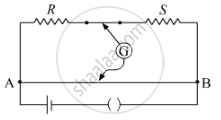
Why are the connections between the resistors in a meter bridge made of thick copper strips?
(a) In a metre bridge [shown in the figure], the balance point is found to be at 39.5 cm from the end A, when the resistor Y is 12.5 Ω. Determine the resistance of X. Why are the connections between resistors in a Wheatstone or meter bridge made of thick copper strips?
(b) Determine the balance point of the bridge above if X and Y are interchanged.
(c) What happens if the galvanometer and cell are interchanged at the balance point of the bridge? Would the galvanometer show any current?
When a resistance of 12 ohm is connected across a cell, its terminal potential difference is balanced by 120 cm length of potentiometer wire. When the resistance of 18 ohm is connected across the same cell, the balancing length is 150 cm. Find the balancing length when the cell is in open circuit. Also calculate the internal resistance of the cell.
Write the principle of working of a metre bridge
Two resistances are connected in the two gaps of a meter bridge. The balance points is 20 cm from the zero end. When resistance of 15 ohm is connected in series with the smaller of the two resistances, the null point shifts to 40 cm. The smaller of the two resistances has the value (in ohm) ______.
In a sensitive meter bridge apparatus the bridge wire should possess ______.
