Advertisements
Advertisements
Question
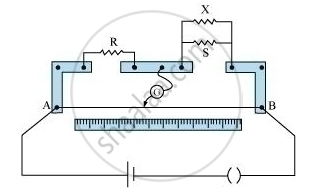
In a meter bridge, the null point is found at a distance of l1 cm from A. If now a resistance of X is connected in parallel with S, the null point occurs at l2 cm. Obtain a formula for X in terms of l1, l2 and S.
Advertisements
Solution
Initially, when X is not connected
`R/S = l_1/(100 -l_1)` [Condition for balance ] ....... (1)
The equivalent resistance (Req) of the combination of X and S is
`1/R_(eq) = 1/X +1/S`
`R_(eq) = (SX)/(X+S)`
`R/R_(eq) = (l_2)/(100 - l_2)`
`(R(X+S))/(SX) = (l_2)/((100 - l_2))` ........ (2)
On dividing (i) by (ii), we obtain
`R/(R(X +S)) xx (SX)/X = (l_1(100 - l_2))/(l_2(100 - l_1)) `
`X /(X +S) = (l_1(100 - l_2))/(l_2(100-l_1)`
`Xl_2 (100 - l_1) = (X +S)l_1(100 - l_2)`
`XI_2 (100 - l_1) = Xl_1(100 - l_2) + Sl_1 (100 - l_2)`
`X = (Sl_1 (100 - l_2))/([l_2(100 -l_1) - l_1 (100 - l_1)])`
This is the expression for X in terms of S, l1 and l2.
