Advertisements
Advertisements
Identify the part of the electromagnetic spectrum which is suitable for radar system used in aircraft navigation.
Concept: Electromagnetic Spectrum
State how a moving coil galvanometer can be converted into an ammeter.
Concept: Moving Coil Galvanometer
State Gauss’ Law.
Concept: Applications of Gauss' Theorem > Electric Field due to a Point Charge
Show that intensity of electric field at a point in broadside position of an electric dipole is given by:
E = `(1/(4 pi epsilon_0)) p/((r^2 + l^2)^(3//2))`
Where the terms have their usual meaning.
Concept: Electric Dipole
Arrangement of an oxygen ion and two hydrogen ions in a water molecule is shown in the figure below.
Calculate the electric dipole moment of a water molecule. Express your answer in terms of e (charge on hydrogen ions), l and θ.

Concept: Electric Dipole
Draw a labelled circuit diagram of a potentiometer to measure the internal resistance ‘r’ of a cell. Write the working formula (derivation is not required).
Concept: Potentiometer
Draw a labelled circuit diagram of a potentiometer to compare emfs of two cells. Write the working formula (Derivation not required).
Concept: Potentiometer
Calculate the shortest wavelength of electromagnetic radiation present in Balmer series of hydrogen spectrum.
Concept: Electromagnetic Spectrum
What happens when an electron collides with a positron?
Concept: Electromagnetic Spectrum
Name the principle on the basis of which optical fibres work.
Concept: Total Internal Reflection
Using Huygen’s wave theory of light, show that the angle of incidence is equal to the angle of reflection. Draw a neat and labelled diagram.
Concept: Huygens Principle
On the basis of Bohr's theory, derive an expression for the radius of the nth orbit of an electron of the hydrogen atom.
Concept: Bohr’s Model for Hydrogen Atom
Write one balanced equation to show Nuclear fission
Concept: Nuclear Fusion
Why nuclear fusion reaction is also called thermo-nuclear reaction?
Concept: Nuclear Fusion
What is ‘Pair production’?
Concept: Atomic Masses and Composition of Nucleus
Draw solar cell V-I characteristics.
Concept: Special Purpose P-n Junction Diodes
A short electric dipole (which consists of two point charges, +q and -q) is placed at the centre 0 and inside a large cube (ABCDEFGH) of length L, as shown in Figure 1. The electric flux, emanating through the cube is:
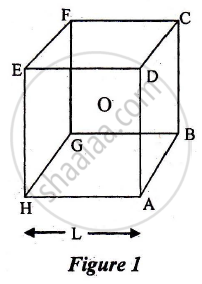
a) `q"/"4piin_9L`
b) zero
c) `q"/"2piin_0L`
d) `q"/"3piin_0L`
Concept: Electric Dipole
Derive an expression for the intensity of electric field at a point in broadside position or on [4)
an equatorial line of an electric dipole.
Concept: Electric Dipole
A closed surface in vacuum encloses charges –q and +3q. The total electric flux emerging out of the surface is :
Concept: Applications of Gauss' Theorem > Electric Field due to a Point Charge
