Advertisements
Advertisements
Questions
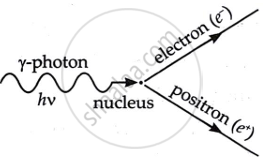
What is ‘Pair production’?
Answer the following question briefly and to the point:
What is Pair production?
Advertisements
Solution 1
An electron and a positron are produced when an intense γ-ray photon strikes a heavy material. One of the substance’s nuclei is responsible for absorbing the photon. Pair creation is the term used to describe this process of energy being transformed into mass.
Equation: \[\ce{\underset{(γ-Photon)}{γ} = \underset{(Electron)}{_-1β^0} + \underset{(Positron)}{_+1β^0}}\]
Solution 2
In a semiconductor, when a covalent bond is broken, the electron comes out, leaving behind a hole (deficiency of electrons). Thus, an electron-hole pair is formed by rupturing a covalent bond.
Solution 3
A positron pair from a gamma ray (or radiation) photon passes close to an atomic nucleus.
RELATED QUESTIONS
Boron has two stable isotopes, `""_5^10"B"` and `""_5^11"B"`. Their respective masses are 10.01294 u and 11.00931 u, and the atomic mass of boron is 10.811 u. Find the abundances of `""_5^10"B"` and `""_5^11"B"`.
Find the Q-value and the kinetic energy of the emitted α-particle in the α-decay of `""_88^226 "Ra"`.
Given `"m"(""_88^226"Ra")` = 226.02540 u, `"m"(""_86^222 "Rn")` = 222.01750 u,
`"m"(""_86^220 "Rn")`= 220.01137 u, `"m"(""_84^216 "Po")`= 216.00189 u.
In a periodic table the average atomic mass of magnesium is given as 24.312 u. The average value is based on their relative natural abundance on earth. The three isotopes and their masses are `""_12^24Mg` (23.98504u), `""_12^25 Mg` (24.98584u) and `""_12^26Mg` (25.98259u). The natural abundance of `""_12^24 Mg` is 78.99% by mass. Calculate the abundances of other two isotopes.
Write one balanced equation to show Emission of `beta^-` (i.e. a negative beta particle)
Show that the density of nucleus over a wide range of nuclei is constant-independent of mass number A.
All nuclides with same mass number A are called ______.
The mass number of a nucleus is equal to the number of:-
Deuteron is a bound state of a neutron and a proton with a binding energy B = 2.2 MeV. A γ-ray of energy E is aimed at a deuteron nucleus to try to break it into a (neutron + proton) such that the n and p move in the direction of the incident γ-ray. If E = B, show that this cannot happen. Hence calculate how much bigger than B must E be for such a process to happen.
In his experiment verifying neutral matter inside the nucleus, James Chadwick observed neutral radiation when beryllium nuclei were bombarded with:
The value of one atomic mass unit (1 u) is:
