Advertisements
Advertisements
Question
Three capacitors of capacitance `C_1 = 3muf` , `C_2 = 6muf` , `C_3 = 10muf` , are connected to a 10V battery as shown in figure 3 below :
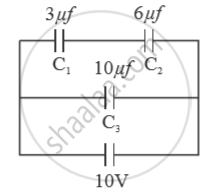
Calculate :
(a) Equivalent capacitance.
(b) Electrostatic potential energy stored in the system
Advertisements
Solution
The equivalent capacitance of the series combinationf of `C_1` and `C_2`, is
`C_12 = (C_1.C_2)/(C_1+C_2)`
= `(3 xx 6)/((3 + 6)) muF = 2muF`
This is in parallel with `C_3`.
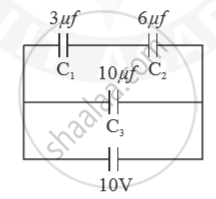
(a) So the equivalent capacitance of the combination of all the three capacitors, is
`C_(eq) = C_12 + C_3 = (2 + 10) = 12muF`
(b) Electrostatic PE stored in the system, is
`E = 1/2 C_(eq) . V^2`
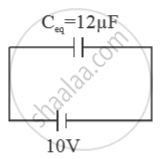
= `1/2 xx 12muF xx (10V)^2 = 600muJ = 6 xx 10^-4 "J"`
APPEARS IN
RELATED QUESTIONS
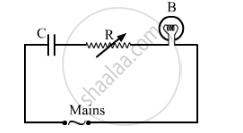
A capacitor 'C', a variable resistor 'R' and a bulb 'B' are connected in series to the ac mains in circuit as shown. The bulb glows with some brightness. How will the glow of the bulb change if (i) a dielectric slab is introduced between the plates of the capacitor, keeping resistance R to be the same; (ii) the resistance R is increased keeping the same capacitance?
A circuit is set up by connecting inductance L = 100 mH, resistor R = 100 Ω and a capacitor of reactance 200 Ω in series. An alternating emf of \[150\sqrt{2}\] V, 500/π Hz is applies across this series combination. Calculate the power dissipated in the resistor.
Suppose a charge +Q1 is given to the positive plate and a charge −Q2 to the negative plate of a capacitor. What is the "charge on the capacitor"?
A parallel-plate capacitor has plates of unequal area. The larger plate is connected to the positive terminal of the battery and the smaller plate to its negative terminal. Let Q, and Q be the charges appearing on the positive and negative plates respectively.
The separation between the plates of a charged parallel-plate capacitor is increased. Which of the following quantities will change?
(a) Charge on the capacitor
(b) Potential difference across the capacitor
(c) Energy of the capacitor
(d) Energy density between the plates
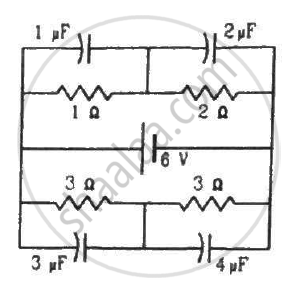
Find the charges on the four capacitors of capacitances 1 μF, 2 μF, 3 μF and 4 μF shown in the figure.
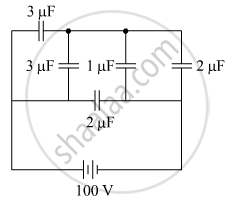
The figure shows a network of five capacitors connected to a 100 V supply. Calculate the total energy stored in the network.
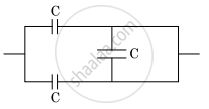
The equivalent capacitance of the combination shown in the figure is ______.
In the circuit shown in figure, initially K1 is closed and K2 is open. What are the charges on each capacitors.
Then K1 was opened and K2 was closed (order is important), What will be the charge on each capacitor now? [C = 1µF]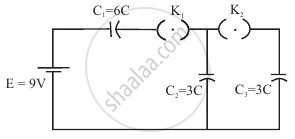
What is the equivalent capacitance of \[n\] identical capacitors, each with capacitance \[C\], connected in series?
