Advertisements
Advertisements
Question
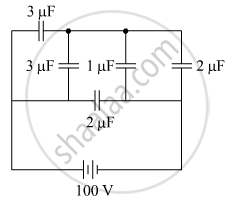
The figure shows a network of five capacitors connected to a 100 V supply. Calculate the total energy stored in the network.
Advertisements
Solution
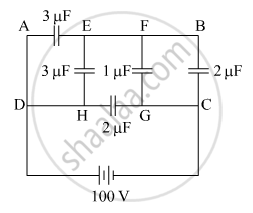
As the both 3 uF capacitors are connected in parallel, so net capacitance between branch EH = 3 + 3 = 6μF
Similarly, the capacitance 2 uF and 1uF at corner B are also connected in parallel, so the net capacitance of branch FG = 2 + 1 = 3 μF
If reconstruct the given figure according to the above calculations, we can see that 6 μF capacitors and 3 μF capacitors are connected in series and another 2 μF capacitor is connected in parallel with both of them.
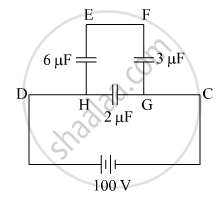
Hence net capacitance Between D and C `= 2 + (3xx6)/(3+6) = 2+2 = 4 mu"F"`
The total capacitance of the circuit, Cnet = 4μF
Total voltage applied, V = 100V
Energy stored in the network `= 1/2 "C"_"net""V"^2 = 1/2 xx 4xx10^-6 xx (100)^2 = 0.02 "J"`
APPEARS IN
RELATED QUESTIONS
Three capacitors each of capacitance 9 pF are connected in series.
- What is the total capacitance of the combination?
- What is the potential difference across each capacitor if the combination is connected to a 120 V supply?
A cylindrical capacitor has two co-axial cylinders of length 15 cm and radii 1.5 cm and 1.4 cm. The outer cylinder is earthed and the inner cylinder is given a charge of 3.5 µC. Determine the capacitance of the system and the potential of the inner cylinder. Neglect end effects (i.e., bending of field lines at the ends).
Deduce an expression for equivalent capacitance C when three capacitors C1, C2 and C3 connected in parallel.
Suppose a charge +Q1 is given to the positive plate and a charge −Q2 to the negative plate of a capacitor. What is the "charge on the capacitor"?
The plates of a parallel-plate capacitor are given equal positive charges. What will be the potential difference between the plates? What will be the charges on the facing surfaces and on the outer surfaces?
If the capacitors in the previous question are joined in parallel, the capacitance and the breakdown voltage of the combination will be
Three capacitors of capacitance `C_1 = 3muf` , `C_2 = 6muf` , `C_3 = 10muf` , are connected to a 10V battery as shown in figure 3 below :
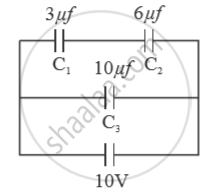
Calculate :
(a) Equivalent capacitance.
(b) Electrostatic potential energy stored in the system
An ac circuit consists of a series combination of circuit elements X and Y. The current is ahead of the voltage in phase by `pi/4`. If element X is a pure resistor of 100 Ω,
(a) name the circuit element Y.
(b) calculate the rms value of current, if rms of voltage is 141 V.
(c) what will happen if the ac source is replaced by a dc source
Capacitors connected in series have ______
Two charges q1 and q2 are placed at (0, 0, d) and (0, 0, – d) respectively. Find locus of points where the potential a zero.
