Advertisements
Advertisements
प्रश्न
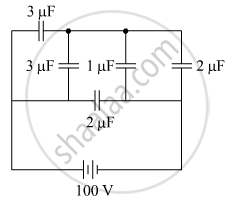
The figure shows a network of five capacitors connected to a 100 V supply. Calculate the total energy stored in the network.
Advertisements
उत्तर
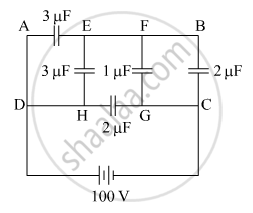
As the both 3 uF capacitors are connected in parallel, so net capacitance between branch EH = 3 + 3 = 6μF
Similarly, the capacitance 2 uF and 1uF at corner B are also connected in parallel, so the net capacitance of branch FG = 2 + 1 = 3 μF
If reconstruct the given figure according to the above calculations, we can see that 6 μF capacitors and 3 μF capacitors are connected in series and another 2 μF capacitor is connected in parallel with both of them.
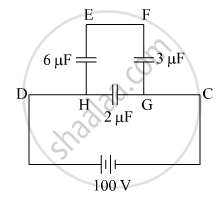
Hence net capacitance Between D and C `= 2 + (3xx6)/(3+6) = 2+2 = 4 mu"F"`
The total capacitance of the circuit, Cnet = 4μF
Total voltage applied, V = 100V
Energy stored in the network `= 1/2 "C"_"net""V"^2 = 1/2 xx 4xx10^-6 xx (100)^2 = 0.02 "J"`
APPEARS IN
संबंधित प्रश्न
If the capacitors in the previous question are joined in parallel, the capacitance and the breakdown voltage of the combination will be
An ac circuit consists of a series combination of circuit elements X and Y. The current is ahead of the voltage in phase by `pi /4` . If element X is a pure resistor of 100Ω ,
(a) name the circuit element Y.
(b) calculate the rms value of current, if rms value of voltage is 141V.
(c) what will happen if the ac source is replaced by a dc source ?
In the circuit shown in figure, initially K1 is closed and K2 is open. What are the charges on each capacitors.
Then K1 was opened and K2 was closed (order is important), What will be the charge on each capacitor now? [C = 1µF]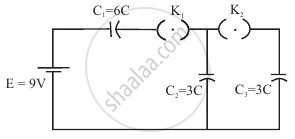
The total charge on the system of capacitors C1 = 1 µF, C2 = 2 µF, C3 = 4 µF and C4 = 3 µF connected in parallel is ______. (Assume a battery of 20 V is connected to the combination)
What is the process of replacing a group of capacitors with a single equivalent capacitor that produces the same electrical effect called?
What is the work done per unit charge in moving a charge from one plate of a capacitor to the other called?
What is the charge relationship for capacitors in series?
In a series combination, which capacitor has the larger voltage drop?
Which expressions give the energy stored in series and parallel combinations, respectively?
