Advertisements
Advertisements
Question
With the help of the graph answer the following -
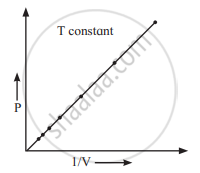
At constant temperature, the Graph shows the relationship between pressure and volume. Represent the relation mathematically.
Advertisements
Solution
P `prop 1/"V"`
APPEARS IN
RELATED QUESTIONS
Explain Why?
"When stating the volume of a gas, the pressure and temperature should also be given."
State (i) the three variables for gas laws and (ii) SI units of these variables.
Give reason for the following:
Gases have a lower density compared to solids or liquids.
Give reason for the following:
Gases exert pressure in all directions.
Convert the following temperature from degree Celcius to kelvin.
273° C
Convert the following pressure value into Pascals.
10 atmosphere
Convert the following pressure value into Pascals.
1 atmosphere
Convert exactly 1.5 atm to pascals
Convert 101.325 kPa to bar.
Convert −100° C to kelvin
Convert 0.124 torr to the standard atmosphere
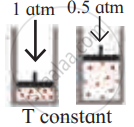
Identify the gas laws from the following diagram.
| Diagram | Gas laws |
 |
______________ |
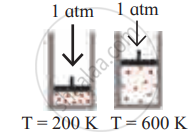
Identify the gas laws from the following diagram.
| Diagram | Gas laws |
 |
______________ |
Solve the following.
The volume of a given mass of a gas at 0°C is 2 dm3. Calculate the new volume of the gas at constant pressure when the temperature is decreased by 10°C.
Use of hot air balloon in sports and meteorological observation is an application of
Assertion: Critical temperature of CO2 is 304 K, it can be liquefied above 304 K.
Reason: For a given mass of gas, volume is to directly proportional to pressure at constant temperature
State Boyle's law.
Explain the following observation.
Aerated water bottles are kept under water during summer
Explain the following observation.
Liquid ammonia bottle is cooled before opening the seal
A small bubble rises from the bottom of a lake where the temperature and pressure are 6°C and 4 atm. to the water surface, where the temperature is 25°C and pressure is 1 atm. Calculate the final volume in (mL) of the bubble, if its initial volume is 1.5 mL.
At 25°C and 1 atm, a cylinder containing 10 L of an ideal gas is connected to the empty cylinder with a capacity of 20 L. The pressures exerted by gas m both the cylinders will be ____________.
For a given mass of an ideal gas, which of the following statements is CORRECT?
A certain sample of gas has a volume of 0.2 L at one atmosphere pressure and 273.15 K. What is the volume of gas at 273.15°C at same pressure?
Volume of a balloon at 25°C and 1 bar pressure is 2.27 L. If the pressure of the gas in balloon is reduced to 0.227 bar, what is the rise in volume of a gas?
If 300 mL of a gas at 26.85°C is cooled to 6.85°C at constant pressure. What will be the final volume of gas?
At what temperature, the volume of gas would become zero?
