Advertisements
Advertisements
Question
A small bubble rises from the bottom of a lake where the temperature and pressure are 6°C and 4 atm. to the water surface, where the temperature is 25°C and pressure is 1 atm. Calculate the final volume in (mL) of the bubble, if its initial volume is 1.5 mL.
Advertisements
Solution
T1 = 6°C + 273 = 279 K
P1 = 4 atm
V1 = 1.5 ml
T2 = 25°C + 273 = 298 K
P2 = 1 atm
V2 = ?
`("P"_1"V"_1)/("T"_1) = ("P"_2"V"_2)/("T"_2)`
V2 = `("P"_1"V"_1)/("T"_1) xx "T"_2/"P"_2`
= `(4 "atm" xx 1.5 "ml" xx 298 "K")/(279 "K" xx 1 "atm")`
V2 = 6.41 ml
APPEARS IN
RELATED QUESTIONS
Convert the following temperature from degree Celcius to kelvin.
−197° C
Identify the gas laws from the following diagram.
| Diagram | Gas laws |
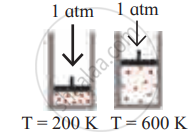 |
______________ |
Consider a sample of a gas in a cylinder with a movable piston.
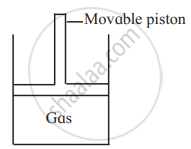
Show diagrammatically the changes in the position of the piston, if pressure is increased from 1.0 bar to 2.0 bar at a constant temperature.
Match the pairs of the following:
| Column ‘A’ | Column ‘B’ |
| a. Boyle’s law | i. at constant pressure and volume |
| b. Charles’ law | ii. at constant temperature |
| iii. at constant pressure |
Write the statement for Boyle’s law
Solve the following.
A balloon is inflated with helium gas at room temperature of 25°C and at 1 bar pressure when its initial volume is 2.27L and allowed to rise in the air. As it rises in the air external pressure decreases and the volume of the gas increases till finally, it bursts when external pressure is 0.3bar. What is the limit at which the volume of the balloon can stay inflated?
Use of hot air balloon in sports and meteorological observation is an application of
Assertion: Critical temperature of CO2 is 304 K, it can be liquefied above 304 K.
Reason: For a given mass of gas, volume is to directly proportional to pressure at constant temperature
A sample of gas at 15°C at 1 atm. has a volume of 2.58 dm3. When the temperature is raised to 38°C at 1 atm does the volume of the gas Increase? If so, calculate the final volume.
If 2 moles of an ideal gas at 546 K has volume of 44.8 L, then what will be it's pressure? (R = 0.082)
