Advertisements
Advertisements
प्रश्न
A small bubble rises from the bottom of a lake where the temperature and pressure are 6°C and 4 atm. to the water surface, where the temperature is 25°C and pressure is 1 atm. Calculate the final volume in (mL) of the bubble, if its initial volume is 1.5 mL.
Advertisements
उत्तर
T1 = 6°C + 273 = 279 K
P1 = 4 atm
V1 = 1.5 ml
T2 = 25°C + 273 = 298 K
P2 = 1 atm
V2 = ?
`("P"_1"V"_1)/("T"_1) = ("P"_2"V"_2)/("T"_2)`
V2 = `("P"_1"V"_1)/("T"_1) xx "T"_2/"P"_2`
= `(4 "atm" xx 1.5 "ml" xx 298 "K")/(279 "K" xx 1 "atm")`
V2 = 6.41 ml
APPEARS IN
संबंधित प्रश्न
Explain Why?
"When stating the volume of a gas, the pressure and temperature should also be given."
Give reason for the following:
Gases have a lower density compared to solids or liquids.
Convert the following temperature from degree Celcius to kelvin.
−15° C
Convert the following temperature from degree Celcius to kelvin.
−197° C
Hot air balloons float in the air because of the low density of the air inside the balloon. Explain this with the help of an appropriate gas law.
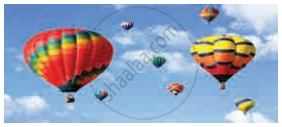
Identify the gas laws from the following diagram.
| Diagram | Gas laws |
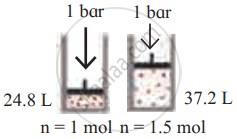 |
______________ |
Consider a sample of a gas in a cylinder with a movable piston.
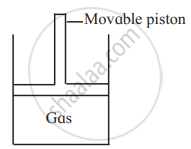
Show diagrammatically the changes in the position of the piston, if pressure is increased from 1.0 bar to 2.0 bar at a constant temperature.
Give the mathematical expression that relates gas volume and moles.
Explain the following observation.
Aerated water bottles are kept under water during summer
Identify the correct relationship between pressure (P), density (d), molar mass (M) and Temperature (T) for an ideal gas from the following.
