Advertisements
Advertisements
प्रश्न
Explain the following observation.
Aerated water bottles are kept under water during summer
Advertisements
उत्तर
In aerated water bottles, CO2 gas is passed through the aqueous solution under pressure because the solubility of the gas in water is not very high. In summer, the solubility of the gas in water is likely to decrease because of the rise in temperature. Thus, in summer, more gas will be present above the liquid surface in the glass bottle.
In case, the pressure of the gas becomes too high, the glass will not be able to withstand the pressure and the bottle may explode. To avoid this, the bottles are kept under water. As a result, the temperature is likely to decrease and the solubility of CO2 is likely to increase in aqueous solution resulting in decreased pressure.
APPEARS IN
संबंधित प्रश्न
Give reason for the following:
Gases exert pressure in all directions.
Convert the following pressure value into Pascals.
107000 Nm−2
Identify the gas laws from the following diagram.
| Diagram | Gas laws |
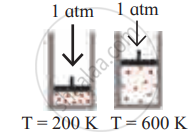 |
______________ |
Consider a sample of a gas in a cylinder with a movable piston.
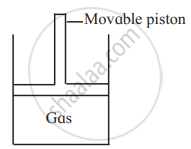
Show diagrammatically the changes in the position of the piston, if pressure is increased from 1.0 bar to 2.0 bar at a constant temperature.
With the help of the graph answer the following -
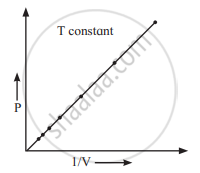
At constant temperature, the Graph shows the relationship between pressure and volume. Represent the relation mathematically.
Explain the following observation.
Liquid ammonia bottle is cooled before opening the seal
Of two samples of nitrogen gas, sample A contains 1.5 moles of nitrogen in a vessel of the volume of 37.6 dm3 at 298 K, and sample B is in a vessel of volume 16.5 dm3 at 298 K. Calculate the number of moles in sample B.
For a given mass of an ideal gas, which of the following statements is CORRECT?
According to Andrews isothermals at what temperature the carbon dioxide gas starts to condense at 73 atmosphere?
Identify the correct relationship between pressure (P), density (d), molar mass (M) and Temperature (T) for an ideal gas from the following.
