Advertisements
Advertisements
प्रश्न
Explain the following observation.
Liquid ammonia bottle is cooled before opening the seal
Advertisements
उत्तर
Liquid ammonia bottle contains the gas under very high pressure. If the bottle is opened as such, then the sudden decrease in pressure will lead to a large increase in the volume of the gas. As a result, the gas will come out of the bottle all of a sudden with force. This will lead to the breakage of the bottle and also causes an accident.
However, if the bottle is cooled under tap water for some time, there will be a decrease in the volume of a gas to a large extent. if the seal is opened now, the gas will come out of the bottle at a slower rate, reduces the chances of an accident.
APPEARS IN
संबंधित प्रश्न
Convert the following temperature from degree Celcius to kelvin.
−15° C
Identify the gas laws from the following diagram.
| Diagram | Gas laws |
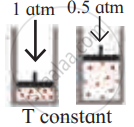 |
______________ |
The temperatures at which real gases obey the ideal gas laws over a wide range of pressure is called __________.
Name two items that can serve as a model for Gay Lusaac’s law and explain.
A sample of gas at 15°C at 1 atm. has a volume of 2.58 dm3. When the temperature is raised to 38°C at 1 atm does the volume of the gas Increase? If so, calculate the final volume.
Of two samples of nitrogen gas, sample A contains 1.5 moles of nitrogen in a vessel of the volume of 37.6 dm3 at 298 K, and sample B is in a vessel of volume 16.5 dm3 at 298 K. Calculate the number of moles in sample B.
Sulphur hexafluoride is a colourless, odourless gas; calculate the pressure exerted by 1.82 moles of the gas in a steel vessel of volume 5.43 dm3 at 69.5 °C, assuming ideal gas behaviour
A certain sample of gas has a volume of 0.2 L at one atmosphere pressure and 273.15 K. What is the volume of gas at 273.15°C at same pressure?
According to Andrews isothermals, the minimum temperature at which carbon dioxide gas obeys Boyles law is ______.
The number of molecules in 8.96 litres of gas at 0°C and 1 atm. pressure is approximately ______.
