Advertisements
Advertisements
प्रश्न
Explain the following observation.
The type of an automobile is inflated to slightly lesser pressure in summer than in winter
Advertisements
उत्तर
The pressure of air is directly proportional to the temperature. Since the temperature is higher in summer than in higher, the pressure of the air in the tube of the lyre is likely to be quite high as compared to winter. It is quite likely that the tube may burst under high pressure in summer, Therefore, it is advisable to inflate the types to lesser pressure in summer than in winter.
APPEARS IN
संबंधित प्रश्न
Give reason for the following:
Gases have a lower density compared to solids or liquids.
Convert the following temperature from degree Celcius to kelvin.
−15° C
Convert 89 kPa to newton per square metre (Nm−2)
With the help of the graph answer the following -
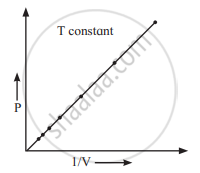
At constant temperature, the Graph shows the relationship between pressure and volume. Represent the relation mathematically.
Give the mathematical expression that relates gas volume and moles.
A sample of gas has a volume of 8.5 dm3 at an unknown temperature. When the sample is submerged in ice water at 0°C, its volume gets reduced to 6.37 dm3. What is its initial temperature?
A small bubble rises from the bottom of a lake where the temperature and pressure are 6°C and 4 atm. to the water surface, where the temperature is 25°C and pressure is 1 atm. Calculate the final volume in (mL) of the bubble, if its initial volume is 1.5 mL.
According to Andrews isothermals at what temperature the carbon dioxide gas starts to condense at 73 atmosphere?
Isochor is the graph plotted between ______.
The volume of 400 cm3 chlorine gas at 400 mm of Hg is decreased to 200 cm3 at constant temperature. What is the new pressure of gas?
