Advertisements
Advertisements
प्रश्न
Explain the following observation.
The size of a weather balloon becomes larger and larger as it ascends up to larger altitude
Advertisements
उत्तर
The volume of the gas is inversely proportional to the pressure at a given temperature according to Boyle’s law. As the weather balloon ascends, the pressure tends to decrease. As a result, the volume of the gas inside the balloon or the size of the balloon is likely to increase.
APPEARS IN
संबंधित प्रश्न
Give reason for the following:
Gases have a lower density compared to solids or liquids.
State the following:
The absolute temperature of a gas at 7°C
Convert 89 kPa to newton per square metre (Nm−2)
Identify the gas laws from the following diagram.
| Diagram | Gas laws |
 |
______________ |
Consider a sample of a gas in a cylinder with a movable piston.
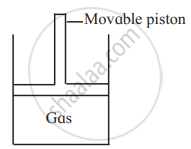
Show diagrammatically the changes in the position of the piston, if the temperature is decreased from 300 K to 150 K at constant pressure.
With the help of the graph answer the following -
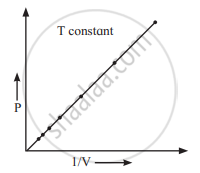
At constant temperature, Write the statement of law.
Solve the following.
A hot air balloon has a volume of 2800 m3 at 99°C. What is the volume if the air cools to 80°C?

A sample of gas has a volume of 8.5 dm3 at an unknown temperature. When the sample is submerged in ice water at 0°C, its volume gets reduced to 6.37 dm3. What is its initial temperature?
Of two samples of nitrogen gas, sample A contains 1.5 moles of nitrogen in a vessel of the volume of 37.6 dm3 at 298 K, and sample B is in a vessel of volume 16.5 dm3 at 298 K. Calculate the number of moles in sample B.
A certain sample of gas has a volume of 0.2 L at one atmosphere pressure and 273.15 K. What is the volume of gas at 273.15°C at same pressure?
