Advertisements
Advertisements
प्रश्न
Explain the following observation.
The size of a weather balloon becomes larger and larger as it ascends up to larger altitude
Advertisements
उत्तर
The volume of the gas is inversely proportional to the pressure at a given temperature according to Boyle’s law. As the weather balloon ascends, the pressure tends to decrease. As a result, the volume of the gas inside the balloon or the size of the balloon is likely to increase.
APPEARS IN
संबंधित प्रश्न
What would be the mass of CO2 occupying a volume of 44 litres at 25°C and 750 mm pressure.
Give reason for the following:
Gases have a lower density compared to solids or liquids.
Convert the following temperature from degree Celcius to kelvin.
25° C
Consider a sample of a gas in a cylinder with a movable piston.
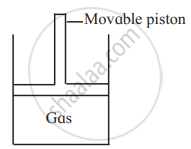
Show diagrammatically the changes in the position of the piston, if the temperature is decreased from 400 K to 300 K, and pressure is decreased from 4 bar to 3 bar.
A sample of gas at 15°C at 1 atm. has a volume of 2.58 dm3. When the temperature is raised to 38°C at 1 atm does the volume of the gas Increase? If so, calculate the final volume.
Sulphur hexafluoride is a colourless, odourless gas; calculate the pressure exerted by 1.82 moles of the gas in a steel vessel of volume 5.43 dm3 at 69.5 °C, assuming ideal gas behaviour
At 25°C and 1 atm, a cylinder containing 10 L of an ideal gas is connected to the empty cylinder with a capacity of 20 L. The pressures exerted by gas m both the cylinders will be ____________.
For a given mass of an ideal gas, which of the following statements is CORRECT?
Isochor is the graph plotted between ______.
The number of molecules in 8.96 litres of gas at 0°C and 1 atm. pressure is approximately ______.
