Advertisements
Advertisements
प्रश्न
Give reason for the following:
Gases exert pressure in all directions.
Gases unlike solids and liquids exert pressure in all directions.
Advertisements
उत्तर १
The gas particles have a very weak attractive force between them and move randomly ultimately exert pressure in all direction. Their molecules are bouncing all around the container because they are so small, then gravity has very little effect on them.
उत्तर २
Impact of gas molecules with high velocity causes pressure to be exerted on the walls.
संबंधित प्रश्न
Convert the following pressure value into Pascals.
1 atmosphere
Hot air balloons float in the air because of the low density of the air inside the balloon. Explain this with the help of an appropriate gas law.
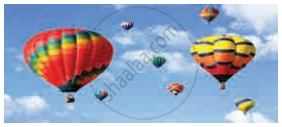
Identify the gas laws from the following diagram.
| Diagram | Gas laws |
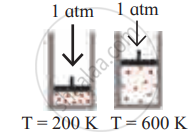 |
______________ |
Solve the following.
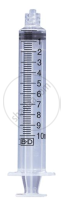
A syringe has a volume of 10.0 cm3 at pressure 1 atm. If you plug the end so that no gas can escape and push the plunger down, what must be the final volume to change the pressure to 3.5 atm?
Use of hot air balloon in sports and meteorological observation is an application of
Explain the following observation.
Aerated water bottles are kept under water during summer
Explain the following observation.
Liquid ammonia bottle is cooled before opening the seal
Of two samples of nitrogen gas, sample A contains 1.5 moles of nitrogen in a vessel of the volume of 37.6 dm3 at 298 K, and sample B is in a vessel of volume 16.5 dm3 at 298 K. Calculate the number of moles in sample B.
The volume of 400 cm3 chlorine gas at 400 mm of Hg is decreased to 200 cm3 at constant temperature. What is the new pressure of gas?
If 2 moles of an ideal gas at 546 K has volume of 44.8 L, then what will be it's pressure? (R = 0.082)
