Advertisements
Advertisements
प्रश्न
Give reason for the following:
Gases have a lower density compared to solids or liquids.
Advertisements
उत्तर
Gases have low densities as the inter-molecular distance between the molecules of gases is very large.
Pressure on the wall = `("Force exerted on the wall")/("Total area of the container wall")`
संबंधित प्रश्न
What is meant by aqueous tension? How is the pressure exerted by a gas corrected to account for aqueous tension?
Convert the following pressure value into Pascals.
10 atmosphere
Consider a sample of a gas in a cylinder with a movable piston.
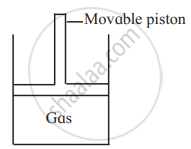
Show diagrammatically the changes in the position of the piston, if the temperature is decreased from 300 K to 150 K at constant pressure.
Match the pairs of the following:
| Column ‘A’ | Column ‘B’ |
| a. Boyle’s law | i. at constant pressure and volume |
| b. Charles’ law | ii. at constant temperature |
| iii. at constant pressure |
Solve the following.
At 0°C, a gas occupies 22.4 liters. How much hot must be the gas in celsius and in kelvin to reach a volume of 25.0 liters?
State Boyle's law.
Sulphur hexafluoride is a colourless, odourless gas; calculate the pressure exerted by 1.82 moles of the gas in a steel vessel of volume 5.43 dm3 at 69.5 °C, assuming ideal gas behaviour
10 g of gas at one atomospheric pressure is cooled from 273.15°C to 0°C keeping the volume constant. What is the final pressure?
If 300 mL of a gas at 26.85°C is cooled to 6.85°C at constant pressure. What will be the final volume of gas?
Identify the correct relationship between pressure (P), density (d), molar mass (M) and Temperature (T) for an ideal gas from the following.
