Advertisements
Advertisements
Question
Give reason for the following:
Gases have a lower density compared to solids or liquids.
Advertisements
Solution
Gases have low densities as the inter-molecular distance between the molecules of gases is very large.
Pressure on the wall = `("Force exerted on the wall")/("Total area of the container wall")`
RELATED QUESTIONS
Convert −100° C to kelvin
Convert 0.124 torr to the standard atmosphere
Identify the gas laws from the following diagram.
| Diagram | Gas laws |
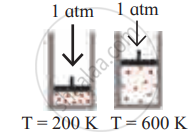 |
______________ |
Consider a sample of a gas in a cylinder with a movable piston.
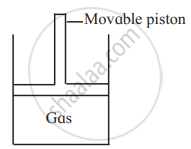
Show diagrammatically the changes in the position of the piston, if the temperature is decreased from 300 K to 150 K at constant pressure.
With the help of the graph answer the following -
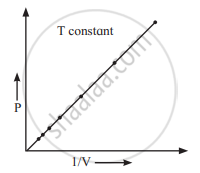
At constant temperature, Identify the law.
Explain the following observation.
Aerated water bottles are kept under water during summer
Of two samples of nitrogen gas, sample A contains 1.5 moles of nitrogen in a vessel of the volume of 37.6 dm3 at 298 K, and sample B is in a vessel of volume 16.5 dm3 at 298 K. Calculate the number of moles in sample B.
Sulphur hexafluoride is a colourless, odourless gas; calculate the pressure exerted by 1.82 moles of the gas in a steel vessel of volume 5.43 dm3 at 69.5 °C, assuming ideal gas behaviour
A certain mass of a gas occupies a volume of 2 dm3 at STP. At what temperature the volume of gas becomes double, keeping the pressure constant?
The volume of 400 cm3 chlorine gas at 400 mm of Hg is decreased to 200 cm3 at constant temperature. What is the new pressure of gas?
