Advertisements
Advertisements
Question
What is meant by aqueous tension? How is the pressure exerted by a gas corrected to account for aqueous tension?
Advertisements
Solution
Gases such as nitrogen and hydrogen are collected over water as shown in the diagram. When the gas is collected over water, the gas is moist and contains water vapour. The total pressure exerted by this moist gas is equal to the sum of the partial pressures of the dry gas and the pressure exerted by water vapour. The partial pressure of water vapour is also known as aqueous tension.
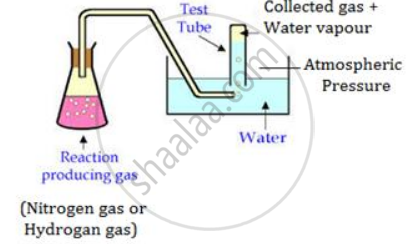
Ptotal = Pgas + Pwater vapour
Pgas = Ptotal- Pwater vapour
Actual pressure of gas = Total pressure - Aqueous tension
APPEARS IN
RELATED QUESTIONS
Convert exactly 1.5 atm to pascals
Hot air balloons float in the air because of the low density of the air inside the balloon. Explain this with the help of an appropriate gas law.

Identify the gas laws from the following diagram.
| Diagram | Gas laws |
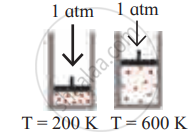 |
______________ |
With the help of the graph answer the following -
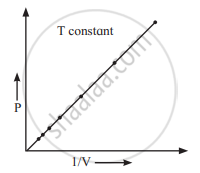
At constant temperature, the Graph shows the relationship between pressure and volume. Represent the relation mathematically.
Solve the following.
The volume of a given mass of a gas at 0°C is 2 dm3. Calculate the new volume of the gas at constant pressure when the temperature is decreased by 10°C.
Explain the following observation.
Liquid ammonia bottle is cooled before opening the seal
For a given mass of an ideal gas, which of the following statements is CORRECT?
According to Andrews isothermals at what temperature the carbon dioxide gas starts to condense at 73 atmosphere?
A certain mass of a gas occupies a volume of 2 dm3 at STP. At what temperature the volume of gas becomes double, keeping the pressure constant?
At what temperature the volume of a gas becomes absolutely zero?
