Advertisements
Advertisements
Question
State Boyle's law.
Advertisements
Solution
Boyle’s law states that at a given temperature. the volume occupied by a fixed mass of a gas is inversely proportional to its pressure.
V α `1/"P"`;
Where T and n are fixed or PV = Constant = k
APPEARS IN
RELATED QUESTIONS
State (i) the three variables for gas laws and (ii) SI units of these variables.
State the following:
The absolute temperature of a gas at 7°C
Answer in one sentence.
A bubble of methane gas rises from the bottom of the North sea. What will happen to the size of the bubble as it rises to the surface?
Convert −100° C to kelvin
Consider a sample of a gas in a cylinder with a movable piston.
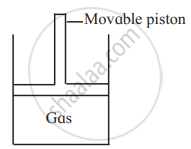
Show diagrammatically the changes in the position of the piston, if the temperature is decreased from 300 K to 150 K at constant pressure.
Match the pairs of the following:
| Column ‘A’ | Column ‘B’ |
| a. Boyle’s law | i. at constant pressure and volume |
| b. Charles’ law | ii. at constant temperature |
| iii. at constant pressure |
Assertion: Critical temperature of CO2 is 304 K, it can be liquefied above 304 K.
Reason: For a given mass of gas, volume is to directly proportional to pressure at constant temperature
Give the mathematical expression that relates gas volume and moles.
According to Andrews isothermals, the minimum temperature at which carbon dioxide gas obeys Boyles law is ______.
According to Andrews isothermals at what temperature the carbon dioxide gas starts to condense at 73 atmosphere?
