Advertisements
Advertisements
Question
A sample of gas has a volume of 8.5 dm3 at an unknown temperature. When the sample is submerged in ice water at 0°C, its volume gets reduced to 6.37 dm3. What is its initial temperature?
Advertisements
Solution
V1 = 8.5 dm3
V2 = 6.37 dm3
T1 = ?
T2 = 0°C = 273 K
`"V"_1/"T"_1 = "V"_2/"T"_2`
`"V"_1 xx ("T"_2/"V"_2) = "T"_1`
T1 = `8.5 "dm"^3 xx (273 "K")/(6.37 "dm"^3)`
T1 = 364.28 K
APPEARS IN
RELATED QUESTIONS
Explain Why?
"When stating the volume of a gas, the pressure and temperature should also be given."
Give reason for the following:
Gases exert pressure in all directions.
Convert the following temperature from degree Celcius to kelvin.
273° C
Identify the gas laws from the following diagram.
| Diagram | Gas laws |
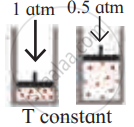 |
______________ |
With the help of the graph answer the following -
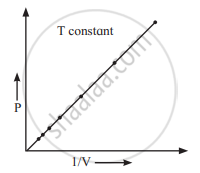
At constant temperature, the Graph shows the relationship between pressure and volume. Represent the relation mathematically.
With the help of the graph answer the following -
At constant temperature, Identify the law.
Give the mathematical expression that relates gas volume and moles.
A sample of gas at 15°C at 1 atm. has a volume of 2.58 dm3. When the temperature is raised to 38°C at 1 atm does the volume of the gas Increase? If so, calculate the final volume.
Hydrochloric acid is treated with a metal to produce hydrogen gas. Suppose a student carries out this reaction and collects a volume of 154.4 × 10⁻³ dm3 of a gas at a pressure of 742 mm of Hg at a temperature of 298 K. What mass of hydrogen gas (in mg) did the student collect?
According to Andrews isothermals at what temperature the carbon dioxide gas starts to condense at 73 atmosphere?
