Advertisements
Advertisements
Question
Of two samples of nitrogen gas, sample A contains 1.5 moles of nitrogen in a vessel of the volume of 37.6 dm3 at 298 K, and sample B is in a vessel of volume 16.5 dm3 at 298 K. Calculate the number of moles in sample B.
Advertisements
Solution
nA = 1.5 mol
nB = ?
VA = 37.6 dm3
VB = 16.5 dm3
(T = 298 K constant)
`"V"_"A"/"n"_"A" = "V"_"B"/"n"_"B"`
`37.6/1.5 = 16.5/"n"_"B"`
`25.06 = 16.5/"n"_"B"`
`"n"_"B" = 16.5/25.06`
`"n"_"B"` = 0.658 mol
∴ The number of moles in sample B is 0.658 mol
APPEARS IN
RELATED QUESTIONS
Give reason for the following:
Gases exert pressure in all directions.
State the following:
The absolute temperature of a gas at 7°C
Convert the following pressure value into Pascals.
107000 Nm−2
Write the statement for Charles’ law
With the help of the graph answer the following -
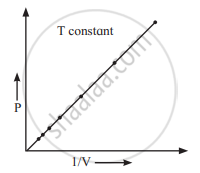
At constant temperature, Write the statement of law.
Solve the following.
At 0°C, a gas occupies 22.4 liters. How much hot must be the gas in celsius and in kelvin to reach a volume of 25.0 liters?
Name two items that can serve as a model for Gay Lusaac’s law and explain.
A small bubble rises from the bottom of a lake where the temperature and pressure are 6°C and 4 atm. to the water surface, where the temperature is 25°C and pressure is 1 atm. Calculate the final volume in (mL) of the bubble, if its initial volume is 1.5 mL.
A gas occupies a volume of 4.2 dm3 at 101 kPa pressure. What volume will gas occupy if the pressure is increased to 235 kPa keeping the temperature constant?
10 g of gas at one atomospheric pressure is cooled from 273.15°C to 0°C keeping the volume constant. What is the final pressure?
