Advertisements
Advertisements
Question
Consider a sample of a gas in a cylinder with a movable piston.
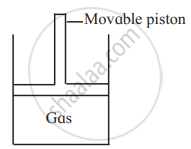
Show diagrammatically the changes in the position of the piston, if the temperature is decreased from 400 K to 300 K, and pressure is decreased from 4 bar to 3 bar.
Advertisements
Solution

According to combined gas law,
`("P"_1"V"_1)/("T"_1)=("P"_2"V"_2)/("T"_2)`
∴ `(4xx1)/400=(3xx"V"_2)/300` .....[Assuming V1 = 1 L]
∴ V2 = 1 L
Thus, the volume of the gas remains the same.
Hence, there will be no change in the position of the piston.
APPEARS IN
RELATED QUESTIONS
What would be the mass of CO2 occupying a volume of 44 litres at 25°C and 750 mm pressure.
Give reason for the following:
Gases have a lower density compared to solids or liquids.
Convert 89 kPa to newton per square metre (Nm−2)
Convert 101.325 kPa to bar.
Convert 0.124 torr to the standard atmosphere
Identify the gas laws from the following diagram.
| Diagram | Gas laws |
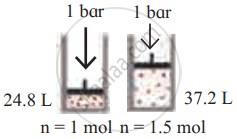 |
______________ |
Consider a sample of a gas in a cylinder with a movable piston.
Show diagrammatically the changes in the position of the piston, if the temperature is decreased from 300 K to 150 K at constant pressure.
Write the statement for Boyle’s law
Write the statement for Charles’ law
With the help of the graph answer the following -
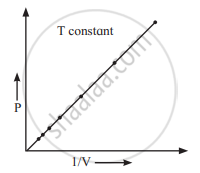
At constant temperature, the Graph shows the relationship between pressure and volume. Represent the relation mathematically.
Assertion: Critical temperature of CO2 is 304 K, it can be liquefied above 304 K.
Reason: For a given mass of gas, volume is to directly proportional to pressure at constant temperature
Give the mathematical expression that relates gas volume and moles.
Explain the following observation.
Aerated water bottles are kept under water during summer
Explain the following observation.
The size of a weather balloon becomes larger and larger as it ascends up to larger altitude
A sample of gas at 15°C at 1 atm. has a volume of 2.58 dm3. When the temperature is raised to 38°C at 1 atm does the volume of the gas Increase? If so, calculate the final volume.
Of two samples of nitrogen gas, sample A contains 1.5 moles of nitrogen in a vessel of the volume of 37.6 dm3 at 298 K, and sample B is in a vessel of volume 16.5 dm3 at 298 K. Calculate the number of moles in sample B.
Sulphur hexafluoride is a colourless, odourless gas; calculate the pressure exerted by 1.82 moles of the gas in a steel vessel of volume 5.43 dm3 at 69.5 °C, assuming ideal gas behaviour
For a given mass of an ideal gas, which of the following statements is CORRECT?
Isochor is the graph plotted between ______.
A gas occupies a volume of 4.2 dm3 at 101 kPa pressure. What volume will gas occupy if the pressure is increased to 235 kPa keeping the temperature constant?
If 2 moles of an ideal gas at 546 K has volume of 44.8 L, then what will be it's pressure? (R = 0.082)
10 g of gas at one atomospheric pressure is cooled from 273.15°C to 0°C keeping the volume constant. What is the final pressure?
The number of molecules in 8.96 litres of gas at 0°C and 1 atm. pressure is approximately ______.
Identify the correct relationship between pressure (P), density (d), molar mass (M) and Temperature (T) for an ideal gas from the following.
