Advertisements
Advertisements
Questions
Give reason for the following:
Gases exert pressure in all directions.
Gases unlike solids and liquids exert pressure in all directions.
Advertisements
Solution 1
The gas particles have a very weak attractive force between them and move randomly ultimately exert pressure in all direction. Their molecules are bouncing all around the container because they are so small, then gravity has very little effect on them.
Solution 2
Impact of gas molecules with high velocity causes pressure to be exerted on the walls.
RELATED QUESTIONS
Convert the following pressure value into Pascals.
1 kPa
Convert the following pressure value into Pascals.
1 atmosphere
Hot air balloons float in the air because of the low density of the air inside the balloon. Explain this with the help of an appropriate gas law.
Identify the gas laws from the following diagram.
| Diagram | Gas laws |
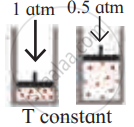 |
______________ |
Consider a sample of a gas in a cylinder with a movable piston.
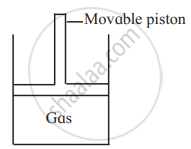
Show diagrammatically the changes in the position of the piston, if the temperature is decreased from 300 K to 150 K at constant pressure.
Give the mathematical expression that relates gas volume and moles.
A small bubble rises from the bottom of a lake where the temperature and pressure are 6°C and 4 atm. to the water surface, where the temperature is 25°C and pressure is 1 atm. Calculate the final volume in (mL) of the bubble, if its initial volume is 1.5 mL.
Volume of a balloon at 25°C and 1 bar pressure is 2.27 L. If the pressure of the gas in balloon is reduced to 0.227 bar, what is the rise in volume of a gas?
Isochor is the graph plotted between ______.
If 300 mL of a gas at 26.85°C is cooled to 6.85°C at constant pressure. What will be the final volume of gas?
