Advertisements
Advertisements
Question
Convert the following pressure value into Pascals.
10 atmosphere
Advertisements
Solution
1 atm = 1.01325 x 10⁵ Pa
∴ 10 atm = 1.01325 x 105 x 10 Pa
= 1.01325 × 10⁶ Pa
10 atmosphere = 1.01325 × 10⁶ Pa
APPEARS IN
RELATED QUESTIONS
What would be the mass of CO2 occupying a volume of 44 litres at 25°C and 750 mm pressure.
What is meant by aqueous tension? How is the pressure exerted by a gas corrected to account for aqueous tension?
Convert the following temperature from degree Celcius to kelvin.
25° C
Convert the following temperature from degree Celcius to kelvin.
−197° C
Convert the following temperature from degree Celcius to kelvin.
273° C
Convert the following pressure value into Pascals.
1 kPa
Convert 89 kPa to newton per square metre (Nm−2)
Convert 101.325 kPa to bar.
Identify the gas laws from the following diagram.
| Diagram | Gas laws |
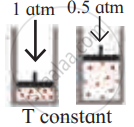 |
______________ |
Identify the gas laws from the following diagram.
| Diagram | Gas laws |
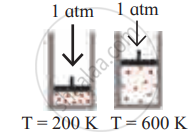 |
______________ |
Write the statement for Charles’ law
Solve the following.
The volume of a given mass of a gas at 0°C is 2 dm3. Calculate the new volume of the gas at constant pressure when the temperature is increased by 10°C.
The temperatures at which real gases obey the ideal gas laws over a wide range of pressure is called __________.
Give the mathematical expression that relates gas volume and moles.
Explain the following observation.
The type of an automobile is inflated to slightly lesser pressure in summer than in winter
Explain the following observation.
The size of a weather balloon becomes larger and larger as it ascends up to larger altitude
A sample of gas at 15°C at 1 atm. has a volume of 2.58 dm3. When the temperature is raised to 38°C at 1 atm does the volume of the gas Increase? If so, calculate the final volume.
A small bubble rises from the bottom of a lake where the temperature and pressure are 6°C and 4 atm. to the water surface, where the temperature is 25°C and pressure is 1 atm. Calculate the final volume in (mL) of the bubble, if its initial volume is 1.5 mL.
For a given mass of an ideal gas, which of the following statements is CORRECT?
A certain sample of gas has a volume of 0.2 L at one atmosphere pressure and 273.15 K. What is the volume of gas at 273.15°C at same pressure?
According to Andrews isothermals, the minimum temperature at which carbon dioxide gas obeys Boyles law is ______.
Volume of a balloon at 25°C and 1 bar pressure is 2.27 L. If the pressure of the gas in balloon is reduced to 0.227 bar, what is the rise in volume of a gas?
Isochor is the graph plotted between ______.
A gas occupies a volume of 4.2 dm3 at 101 kPa pressure. What volume will gas occupy if the pressure is increased to 235 kPa keeping the temperature constant?
The volume of 400 cm3 chlorine gas at 400 mm of Hg is decreased to 200 cm3 at constant temperature. What is the new pressure of gas?
At what temperature, the volume of gas would become zero?
The number of molecules in 8.96 litres of gas at 0°C and 1 atm. pressure is approximately ______.
Identify the correct relationship between pressure (P), density (d), molar mass (M) and Temperature (T) for an ideal gas from the following.
