Advertisements
Advertisements
Question
Convert the following temperature from degree Celcius to kelvin.
25° C
Advertisements
Solution
T(K) = t° C + 273.15
∴ T(K) = 25° C + 273.15
= 298.15 K
APPEARS IN
RELATED QUESTIONS
State (i) the three variables for gas laws and (ii) SI units of these variables.
Convert the following temperature from degree Celcius to kelvin.
−15° C
Convert exactly 1.5 atm to pascals
Convert 101.325 kPa to bar.
Hot air balloons float in the air because of the low density of the air inside the balloon. Explain this with the help of an appropriate gas law.

Identify the gas laws from the following diagram.
| Diagram | Gas laws |
 |
______________ |
Identify the gas laws from the following diagram.
| Diagram | Gas laws |
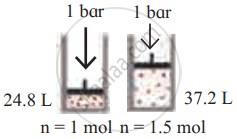 |
______________ |
Consider a sample of a gas in a cylinder with a movable piston.
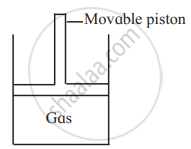
Show diagrammatically the changes in the position of the piston, if the temperature is decreased from 300 K to 150 K at constant pressure.
Consider a sample of a gas in a cylinder with a movable piston.
Show diagrammatically the changes in the position of the piston, if the temperature is decreased from 400 K to 300 K, and pressure is decreased from 4 bar to 3 bar.
Write the statement for Charles’ law
With the help of the graph answer the following -
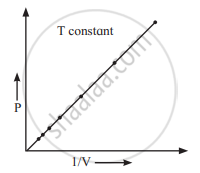
At constant temperature, Identify the law.
Solve the following.
A balloon is inflated with helium gas at room temperature of 25°C and at 1 bar pressure when its initial volume is 2.27L and allowed to rise in the air. As it rises in the air external pressure decreases and the volume of the gas increases till finally, it bursts when external pressure is 0.3bar. What is the limit at which the volume of the balloon can stay inflated?
Solve the following.
The volume of a given mass of a gas at 0°C is 2 dm3. Calculate the new volume of the gas at constant pressure when the temperature is increased by 10°C.
The temperatures at which real gases obey the ideal gas laws over a wide range of pressure is called __________.
Use of hot air balloon in sports and meteorological observation is an application of
Assertion: Critical temperature of CO2 is 304 K, it can be liquefied above 304 K.
Reason: For a given mass of gas, volume is to directly proportional to pressure at constant temperature
State Boyle's law.
Name two items that can serve as a model for Gay Lusaac’s law and explain.
Give the mathematical expression that relates gas volume and moles.
A sample of gas has a volume of 8.5 dm3 at an unknown temperature. When the sample is submerged in ice water at 0°C, its volume gets reduced to 6.37 dm3. What is its initial temperature?
Of two samples of nitrogen gas, sample A contains 1.5 moles of nitrogen in a vessel of the volume of 37.6 dm3 at 298 K, and sample B is in a vessel of volume 16.5 dm3 at 298 K. Calculate the number of moles in sample B.
A certain sample of gas has a volume of 0.2 L at one atmosphere pressure and 273.15 K. What is the volume of gas at 273.15°C at same pressure?
According to Andrews isothermals at what temperature the carbon dioxide gas starts to condense at 73 atmosphere?
At what temperature, the volume of gas would become zero?
The number of molecules in 8.96 litres of gas at 0°C and 1 atm. pressure is approximately ______.
