Advertisements
Advertisements
Question
Explain the following observation.
Liquid ammonia bottle is cooled before opening the seal
Advertisements
Solution
Liquid ammonia bottle contains the gas under very high pressure. If the bottle is opened as such, then the sudden decrease in pressure will lead to a large increase in the volume of the gas. As a result, the gas will come out of the bottle all of a sudden with force. This will lead to the breakage of the bottle and also causes an accident.
However, if the bottle is cooled under tap water for some time, there will be a decrease in the volume of a gas to a large extent. if the seal is opened now, the gas will come out of the bottle at a slower rate, reduces the chances of an accident.
APPEARS IN
RELATED QUESTIONS
State the following:
The absolute temperature of a gas at 7°C
Convert the following temperature from degree Celcius to kelvin.
−15° C
Convert exactly 1.5 atm to pascals
Consider a sample of a gas in a cylinder with a movable piston.
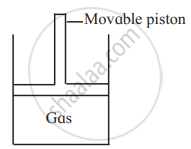
Show diagrammatically the changes in the position of the piston, if the temperature is decreased from 300 K to 150 K at constant pressure.
Solve the following.
At 0°C, a gas occupies 22.4 liters. How much hot must be the gas in celsius and in kelvin to reach a volume of 25.0 liters?
Use of hot air balloon in sports and meteorological observation is an application of
Explain the following observation.
Aerated water bottles are kept under water during summer
At 25°C and 1 atm, a cylinder containing 10 L of an ideal gas is connected to the empty cylinder with a capacity of 20 L. The pressures exerted by gas m both the cylinders will be ____________.
A certain sample of gas has a volume of 0.2 L at one atmosphere pressure and 273.15 K. What is the volume of gas at 273.15°C at same pressure?
A certain mass of a gas occupies a volume of 2 dm3 at STP. At what temperature the volume of gas becomes double, keeping the pressure constant?
