Advertisements
Advertisements
Question
Sulphur hexafluoride is a colourless, odourless gas; calculate the pressure exerted by 1.82 moles of the gas in a steel vessel of volume 5.43 dm3 at 69.5 °C, assuming ideal gas behaviour
Advertisements
Solution
n = 1.82 mole
V = 5.43 dm3
T = 69.5 + 273 = 342.5
P = ?
PV = nRT
P = `"nRT"/"V"`
P = `(1.82 "mol" xx 0.0821 "dm"^3 "atm mol"^-1 "K"^-1 xx 342.5 "K")/(5.43 "dm"^3)`
P = 9.425 atm
APPEARS IN
RELATED QUESTIONS
Convert the following pressure value into Pascals.
1 atmosphere
Convert exactly 1.5 atm to pascals
With the help of the graph answer the following -
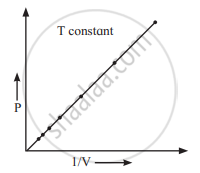
At constant temperature, Identify the law.
Solve the following.
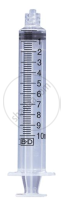
A syringe has a volume of 10.0 cm3 at pressure 1 atm. If you plug the end so that no gas can escape and push the plunger down, what must be the final volume to change the pressure to 3.5 atm?
Assertion: Critical temperature of CO2 is 304 K, it can be liquefied above 304 K.
Reason: For a given mass of gas, volume is to directly proportional to pressure at constant temperature
Of two samples of nitrogen gas, sample A contains 1.5 moles of nitrogen in a vessel of the volume of 37.6 dm3 at 298 K, and sample B is in a vessel of volume 16.5 dm3 at 298 K. Calculate the number of moles in sample B.
A small bubble rises from the bottom of a lake where the temperature and pressure are 6°C and 4 atm. to the water surface, where the temperature is 25°C and pressure is 1 atm. Calculate the final volume in (mL) of the bubble, if its initial volume is 1.5 mL.
Volume of a balloon at 25°C and 1 bar pressure is 2.27 L. If the pressure of the gas in balloon is reduced to 0.227 bar, what is the rise in volume of a gas?
At what temperature the volume of a gas becomes absolutely zero?
Isochor is the graph plotted between ______.
