Advertisements
Advertisements
प्रश्न
Sulphur hexafluoride is a colourless, odourless gas; calculate the pressure exerted by 1.82 moles of the gas in a steel vessel of volume 5.43 dm3 at 69.5 °C, assuming ideal gas behaviour
Advertisements
उत्तर
n = 1.82 mole
V = 5.43 dm3
T = 69.5 + 273 = 342.5
P = ?
PV = nRT
P = `"nRT"/"V"`
P = `(1.82 "mol" xx 0.0821 "dm"^3 "atm mol"^-1 "K"^-1 xx 342.5 "K")/(5.43 "dm"^3)`
P = 9.425 atm
APPEARS IN
संबंधित प्रश्न
Convert the following pressure value into Pascals.
1 kPa
Convert exactly 1.5 atm to pascals
Convert 0.124 torr to the standard atmosphere
Hot air balloons float in the air because of the low density of the air inside the balloon. Explain this with the help of an appropriate gas law.
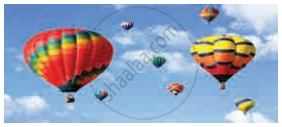
Identify the gas laws from the following diagram.
| Diagram | Gas laws |
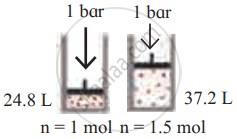 |
______________ |
Match the pairs of the following:
| Column ‘A’ | Column ‘B’ |
| a. Boyle’s law | i. at constant pressure and volume |
| b. Charles’ law | ii. at constant temperature |
| iii. at constant pressure |
With the help of the graph answer the following -
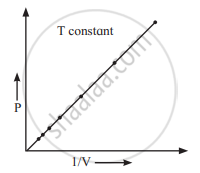
At constant temperature, the Graph shows the relationship between pressure and volume. Represent the relation mathematically.
Solve the following.
A hot air balloon has a volume of 2800 m3 at 99°C. What is the volume if the air cools to 80°C?
At what temperature the volume of a gas becomes absolutely zero?
If 300 mL of a gas at 26.85°C is cooled to 6.85°C at constant pressure. What will be the final volume of gas?
