Advertisements
Advertisements
प्रश्न
Sulphur hexafluoride is a colourless, odourless gas; calculate the pressure exerted by 1.82 moles of the gas in a steel vessel of volume 5.43 dm3 at 69.5 °C, assuming ideal gas behaviour
Advertisements
उत्तर
n = 1.82 mole
V = 5.43 dm3
T = 69.5 + 273 = 342.5
P = ?
PV = nRT
P = `"nRT"/"V"`
P = `(1.82 "mol" xx 0.0821 "dm"^3 "atm mol"^-1 "K"^-1 xx 342.5 "K")/(5.43 "dm"^3)`
P = 9.425 atm
APPEARS IN
संबंधित प्रश्न
Explain Why?
"When stating the volume of a gas, the pressure and temperature should also be given."
Convert the following temperature from degree Celcius to kelvin.
273° C
Identify the gas laws from the following diagram.
| Diagram | Gas laws |
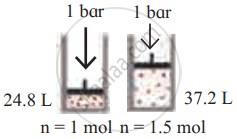 |
______________ |
Consider a sample of a gas in a cylinder with a movable piston.
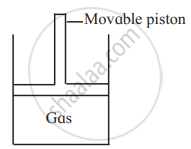
Show diagrammatically the changes in the position of the piston, if pressure is increased from 1.0 bar to 2.0 bar at a constant temperature.
The temperatures at which real gases obey the ideal gas laws over a wide range of pressure is called __________.
A sample of gas at 15°C at 1 atm. has a volume of 2.58 dm3. When the temperature is raised to 38°C at 1 atm does the volume of the gas Increase? If so, calculate the final volume.
For a given mass of an ideal gas, which of the following statements is CORRECT?
A certain mass of a gas occupies a volume of 2 dm3 at STP. At what temperature the volume of gas becomes double, keeping the pressure constant?
At what temperature the volume of a gas becomes absolutely zero?
If 2 moles of an ideal gas at 546 K has volume of 44.8 L, then what will be it's pressure? (R = 0.082)
