Advertisements
Advertisements
प्रश्न
Of two samples of nitrogen gas, sample A contains 1.5 moles of nitrogen in a vessel of the volume of 37.6 dm3 at 298 K, and sample B is in a vessel of volume 16.5 dm3 at 298 K. Calculate the number of moles in sample B.
Advertisements
उत्तर
nA = 1.5 mol
nB = ?
VA = 37.6 dm3
VB = 16.5 dm3
(T = 298 K constant)
`"V"_"A"/"n"_"A" = "V"_"B"/"n"_"B"`
`37.6/1.5 = 16.5/"n"_"B"`
`25.06 = 16.5/"n"_"B"`
`"n"_"B" = 16.5/25.06`
`"n"_"B"` = 0.658 mol
∴ The number of moles in sample B is 0.658 mol
APPEARS IN
संबंधित प्रश्न
Explain Why?
"When stating the volume of a gas, the pressure and temperature should also be given."
Convert 89 kPa to newton per square metre (Nm−2)
Identify the gas laws from the following diagram.
| Diagram | Gas laws |
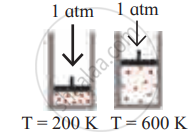 |
______________ |
With the help of the graph answer the following -
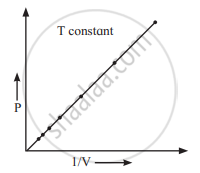
At constant temperature, Write the statement of law.
Solve the following.
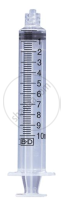
A syringe has a volume of 10.0 cm3 at pressure 1 atm. If you plug the end so that no gas can escape and push the plunger down, what must be the final volume to change the pressure to 3.5 atm?
Assertion: Critical temperature of CO2 is 304 K, it can be liquefied above 304 K.
Reason: For a given mass of gas, volume is to directly proportional to pressure at constant temperature
Name two items that can serve as a model for Gay Lusaac’s law and explain.
Give the mathematical expression that relates gas volume and moles.
A certain sample of gas has a volume of 0.2 L at one atmosphere pressure and 273.15 K. What is the volume of gas at 273.15°C at same pressure?
Identify the correct relationship between pressure (P), density (d), molar mass (M) and Temperature (T) for an ideal gas from the following.
