Advertisements
Advertisements
प्रश्न
A sample of gas has a volume of 8.5 dm3 at an unknown temperature. When the sample is submerged in ice water at 0°C, its volume gets reduced to 6.37 dm3. What is its initial temperature?
Advertisements
उत्तर
V1 = 8.5 dm3
V2 = 6.37 dm3
T1 = ?
T2 = 0°C = 273 K
`"V"_1/"T"_1 = "V"_2/"T"_2`
`"V"_1 xx ("T"_2/"V"_2) = "T"_1`
T1 = `8.5 "dm"^3 xx (273 "K")/(6.37 "dm"^3)`
T1 = 364.28 K
APPEARS IN
संबंधित प्रश्न
Give reason for the following:
Gases exert pressure in all directions.
Identify the gas laws from the following diagram.
| Diagram | Gas laws |
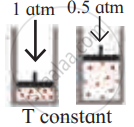 |
______________ |
With the help of the graph answer the following -
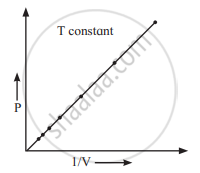
At constant temperature, Identify the law.
Solve the following.
At 0°C, a gas occupies 22.4 liters. How much hot must be the gas in celsius and in kelvin to reach a volume of 25.0 liters?
Assertion: Critical temperature of CO2 is 304 K, it can be liquefied above 304 K.
Reason: For a given mass of gas, volume is to directly proportional to pressure at constant temperature
Explain the following observation.
The size of a weather balloon becomes larger and larger as it ascends up to larger altitude
Hydrochloric acid is treated with a metal to produce hydrogen gas. Suppose a student carries out this reaction and collects a volume of 154.4 × 10⁻³ dm3 of a gas at a pressure of 742 mm of Hg at a temperature of 298 K. What mass of hydrogen gas (in mg) did the student collect?
At 25°C and 1 atm, a cylinder containing 10 L of an ideal gas is connected to the empty cylinder with a capacity of 20 L. The pressures exerted by gas m both the cylinders will be ____________.
For a given mass of an ideal gas, which of the following statements is CORRECT?
Identify the correct relationship between pressure (P), density (d), molar mass (M) and Temperature (T) for an ideal gas from the following.
