Advertisements
Advertisements
प्रश्न
A sample of gas has a volume of 8.5 dm3 at an unknown temperature. When the sample is submerged in ice water at 0°C, its volume gets reduced to 6.37 dm3. What is its initial temperature?
Advertisements
उत्तर
V1 = 8.5 dm3
V2 = 6.37 dm3
T1 = ?
T2 = 0°C = 273 K
`"V"_1/"T"_1 = "V"_2/"T"_2`
`"V"_1 xx ("T"_2/"V"_2) = "T"_1`
T1 = `8.5 "dm"^3 xx (273 "K")/(6.37 "dm"^3)`
T1 = 364.28 K
APPEARS IN
संबंधित प्रश्न
Give reason for the following:
Gases have a lower density compared to solids or liquids.
Convert the following pressure value into Pascals.
1 kPa
Convert the following pressure value into Pascals.
1 atmosphere
Convert −100° C to kelvin
Identify the gas laws from the following diagram.
| Diagram | Gas laws |
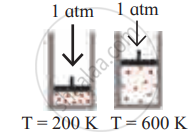 |
______________ |
Consider a sample of a gas in a cylinder with a movable piston.
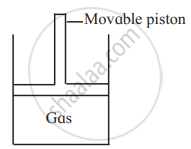
Show diagrammatically the changes in the position of the piston, if pressure is increased from 1.0 bar to 2.0 bar at a constant temperature.
Consider a sample of a gas in a cylinder with a movable piston.
Show diagrammatically the changes in the position of the piston, if the temperature is decreased from 400 K to 300 K, and pressure is decreased from 4 bar to 3 bar.
With the help of the graph answer the following -
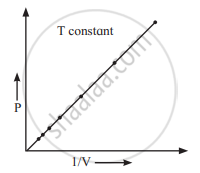
At constant temperature, Write the statement of law.
Assertion: Critical temperature of CO2 is 304 K, it can be liquefied above 304 K.
Reason: For a given mass of gas, volume is to directly proportional to pressure at constant temperature
The volume of 400 cm3 chlorine gas at 400 mm of Hg is decreased to 200 cm3 at constant temperature. What is the new pressure of gas?
