Advertisements
Advertisements
प्रश्न
A sample of gas at 15°C at 1 atm. has a volume of 2.58 dm3. When the temperature is raised to 38°C at 1 atm does the volume of the gas Increase? If so, calculate the final volume.
Advertisements
उत्तर
T1 = 15°C + 273
T2 = 38°C + 273
T1 = 228 K
T2 = 311 K
V1 = 2.58 dm3
V2 = ?
(P = 1 atom constant)
`"V"_1/"T"_1 = "V"_2/"T"_2`
V2 = `("V"_1/"T"_1)` × T2
= `(2.58 "dm"^3)/(288 "K") xx 311 "K"`
V2 = 2.78 dm3
i.e, volume increased from 2.58 dm3 to 2.78 dm3
APPEARS IN
संबंधित प्रश्न
Explain Why?
"When stating the volume of a gas, the pressure and temperature should also be given."
Convert the following temperature from degree Celcius to kelvin.
−197° C
Convert the following pressure value into Pascals.
107000 Nm−2
Convert the following pressure value into Pascals.
1 atmosphere
Convert 101.325 kPa to bar.
Convert −100° C to kelvin
Identify the gas laws from the following diagram.
| Diagram | Gas laws |
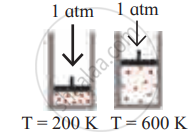 |
______________ |
Consider a sample of a gas in a cylinder with a movable piston.
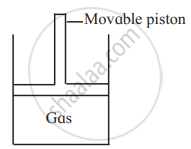
Show diagrammatically the changes in the position of the piston, if pressure is increased from 1.0 bar to 2.0 bar at a constant temperature.
Sulphur hexafluoride is a colourless, odourless gas; calculate the pressure exerted by 1.82 moles of the gas in a steel vessel of volume 5.43 dm3 at 69.5 °C, assuming ideal gas behaviour
If 300 mL of a gas at 26.85°C is cooled to 6.85°C at constant pressure. What will be the final volume of gas?
