Advertisements
Advertisements
Question
A sample of gas at 15°C at 1 atm. has a volume of 2.58 dm3. When the temperature is raised to 38°C at 1 atm does the volume of the gas Increase? If so, calculate the final volume.
Advertisements
Solution
T1 = 15°C + 273
T2 = 38°C + 273
T1 = 228 K
T2 = 311 K
V1 = 2.58 dm3
V2 = ?
(P = 1 atom constant)
`"V"_1/"T"_1 = "V"_2/"T"_2`
V2 = `("V"_1/"T"_1)` × T2
= `(2.58 "dm"^3)/(288 "K") xx 311 "K"`
V2 = 2.78 dm3
i.e, volume increased from 2.58 dm3 to 2.78 dm3
APPEARS IN
RELATED QUESTIONS
Convert the following temperature from degree Celcius to kelvin.
−15° C
Convert the following pressure value into Pascals.
1 kPa
Consider a sample of a gas in a cylinder with a movable piston.
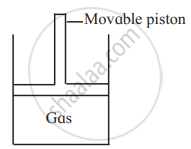
Show diagrammatically the changes in the position of the piston, if the temperature is decreased from 300 K to 150 K at constant pressure.
Consider a sample of a gas in a cylinder with a movable piston.
Show diagrammatically the changes in the position of the piston, if the temperature is decreased from 400 K to 300 K, and pressure is decreased from 4 bar to 3 bar.
Assertion: Critical temperature of CO2 is 304 K, it can be liquefied above 304 K.
Reason: For a given mass of gas, volume is to directly proportional to pressure at constant temperature
Give the mathematical expression that relates gas volume and moles.
Explain the following observation.
Aerated water bottles are kept under water during summer
Isochor is the graph plotted between ______.
A gas occupies a volume of 4.2 dm3 at 101 kPa pressure. What volume will gas occupy if the pressure is increased to 235 kPa keeping the temperature constant?
Identify the correct relationship between pressure (P), density (d), molar mass (M) and Temperature (T) for an ideal gas from the following.
