Advertisements
Advertisements
Question
With the help of the graph answer the following -
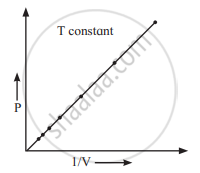
At constant temperature, Write the statement of law.
Advertisements
Solution
Statement of Boyle’s law: For a fixed mass (number of moles ‘n’) of a gas at a constant temperature, the pressure (P) of the gas is inversely proportional to the volume (V) of the gas.
OR
At constant temperature, the pressure of a fixed amount (number of moles) of a gas varies inversely with its volume.
APPEARS IN
RELATED QUESTIONS
Explain Why?
"When stating the volume of a gas, the pressure and temperature should also be given."
What would be the mass of CO2 occupying a volume of 44 litres at 25°C and 750 mm pressure.
Convert the following temperature from degree Celcius to kelvin.
−15° C
Convert the following pressure value into Pascals.
10 atmosphere
Convert the following pressure value into Pascals.
1 kPa
Convert the following pressure value into Pascals.
107000 Nm−2
Convert 101.325 kPa to bar.
Convert −100° C to kelvin
Identify the gas laws from the following diagram.
| Diagram | Gas laws |
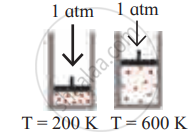 |
______________ |
Identify the gas laws from the following diagram.
| Diagram | Gas laws |
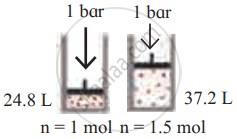 |
______________ |
Consider a sample of a gas in a cylinder with a movable piston.
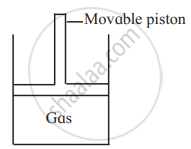
Show diagrammatically the changes in the position of the piston, if pressure is increased from 1.0 bar to 2.0 bar at a constant temperature.
Consider a sample of a gas in a cylinder with a movable piston.
Show diagrammatically the changes in the position of the piston, if the temperature is decreased from 300 K to 150 K at constant pressure.
Write the statement for Boyle’s law
Write the statement for Charles’ law
Solve the following.
At 0°C, a gas occupies 22.4 liters. How much hot must be the gas in celsius and in kelvin to reach a volume of 25.0 liters?
The temperatures at which real gases obey the ideal gas laws over a wide range of pressure is called __________.
Assertion: Critical temperature of CO2 is 304 K, it can be liquefied above 304 K.
Reason: For a given mass of gas, volume is to directly proportional to pressure at constant temperature
State Boyle's law.
Explain the following observation.
The size of a weather balloon becomes larger and larger as it ascends up to larger altitude
Hydrochloric acid is treated with a metal to produce hydrogen gas. Suppose a student carries out this reaction and collects a volume of 154.4 × 10⁻³ dm3 of a gas at a pressure of 742 mm of Hg at a temperature of 298 K. What mass of hydrogen gas (in mg) did the student collect?
Volume of a balloon at 25°C and 1 bar pressure is 2.27 L. If the pressure of the gas in balloon is reduced to 0.227 bar, what is the rise in volume of a gas?
A certain mass of a gas occupies a volume of 2 dm3 at STP. At what temperature the volume of gas becomes double, keeping the pressure constant?
At what temperature the volume of a gas becomes absolutely zero?
The number of molecules in 8.96 litres of gas at 0°C and 1 atm. pressure is approximately ______.
