Advertisements
Advertisements
Question
Hydrochloric acid is treated with a metal to produce hydrogen gas. Suppose a student carries out this reaction and collects a volume of 154.4 × 10⁻³ dm3 of a gas at a pressure of 742 mm of Hg at a temperature of 298 K. What mass of hydrogen gas (in mg) did the student collect?
Advertisements
Solution
Given, V = 154.4 × 10⁻³ dm3
P = 742 mm of Hg
T = 298 K
m = ?
n = `"PV"/"RT"`
= `(742 "mm Hg" xx 154.4 xx 10^-13 "L")/(62 "mm Hg L K"^-1 "mol"^-1 xx 298 "K")`
= 0.006 mol
n = `"Mass"/("Molar mass")`
Mass = n × Molar Mass
= 0.0006 × 2.016
= 0.0121 g
= 12.1 mg
APPEARS IN
RELATED QUESTIONS
State the following:
The absolute temperature of a gas at 7°C
Identify the gas laws from the following diagram.
| Diagram | Gas laws |
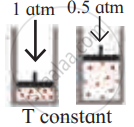 |
______________ |
Identify the gas laws from the following diagram.
| Diagram | Gas laws |
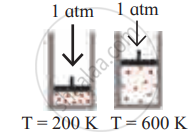 |
______________ |
Write the statement for Charles’ law
Solve the following.
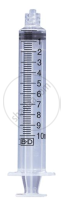
A syringe has a volume of 10.0 cm3 at pressure 1 atm. If you plug the end so that no gas can escape and push the plunger down, what must be the final volume to change the pressure to 3.5 atm?
Give the mathematical expression that relates gas volume and moles.
A sample of gas at 15°C at 1 atm. has a volume of 2.58 dm3. When the temperature is raised to 38°C at 1 atm does the volume of the gas Increase? If so, calculate the final volume.
At 25°C and 1 atm, a cylinder containing 10 L of an ideal gas is connected to the empty cylinder with a capacity of 20 L. The pressures exerted by gas m both the cylinders will be ____________.
A certain mass of a gas occupies a volume of 2 dm3 at STP. At what temperature the volume of gas becomes double, keeping the pressure constant?
At what temperature, the volume of gas would become zero?
