Advertisements
Advertisements
प्रश्न
Convert 101.325 kPa to bar.
Advertisements
उत्तर
101.325 kPa to bar:
1 bar = 1.0 × 10⁵ Pa
= 1.0 × 10² kPa
∴ 100 kPa = 1 bar
∴ 101.325 kPa = `(1xx101.325)/100`
= 1.01325 bar
APPEARS IN
संबंधित प्रश्न
What is meant by aqueous tension? How is the pressure exerted by a gas corrected to account for aqueous tension?
Convert the following pressure value into Pascals.
107000 Nm−2
Convert the following pressure value into Pascals.
1 atmosphere
Convert 89 kPa to newton per square metre (Nm−2)
Convert 0.124 torr to the standard atmosphere
Identify the gas laws from the following diagram.
| Diagram | Gas laws |
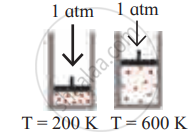 |
______________ |
Identify the gas laws from the following diagram.
| Diagram | Gas laws |
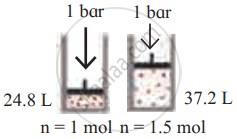 |
______________ |
Consider a sample of a gas in a cylinder with a movable piston.
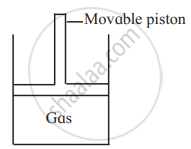
Show diagrammatically the changes in the position of the piston, if the temperature is decreased from 300 K to 150 K at constant pressure.
Match the pairs of the following:
| Column ‘A’ | Column ‘B’ |
| a. Boyle’s law | i. at constant pressure and volume |
| b. Charles’ law | ii. at constant temperature |
| iii. at constant pressure |
With the help of the graph answer the following -
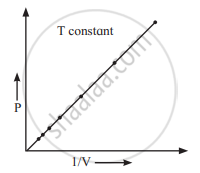
At constant temperature, Identify the law.
With the help of the graph answer the following -
At constant temperature, Write the statement of law.
Solve the following.
The volume of a given mass of a gas at 0°C is 2 dm3. Calculate the new volume of the gas at constant pressure when the temperature is decreased by 10°C.
Solve the following.
At 0°C, a gas occupies 22.4 liters. How much hot must be the gas in celsius and in kelvin to reach a volume of 25.0 liters?
The temperatures at which real gases obey the ideal gas laws over a wide range of pressure is called __________.
Use of hot air balloon in sports and meteorological observation is an application of
Name two items that can serve as a model for Gay Lusaac’s law and explain.
Explain the following observation.
Aerated water bottles are kept under water during summer
A sample of gas has a volume of 8.5 dm3 at an unknown temperature. When the sample is submerged in ice water at 0°C, its volume gets reduced to 6.37 dm3. What is its initial temperature?
According to Andrews isothermals, the minimum temperature at which carbon dioxide gas obeys Boyles law is ______.
According to Andrews isothermals at what temperature the carbon dioxide gas starts to condense at 73 atmosphere?
Isochor is the graph plotted between ______.
If 2 moles of an ideal gas at 546 K has volume of 44.8 L, then what will be it's pressure? (R = 0.082)
If 300 mL of a gas at 26.85°C is cooled to 6.85°C at constant pressure. What will be the final volume of gas?
At what temperature, the volume of gas would become zero?
