Advertisements
Advertisements
प्रश्न
Write the statement for Boyle’s law
Advertisements
उत्तर
Statement of Boyle’s law: For a fixed mass (number of moles ‘n’) of a gas at a constant temperature, the pressure (P) of the gas is inversely proportional to the volume (V) of the gas.
OR
At constant temperature, the pressure of a fixed amount (number of moles) of a gas varies inversely with its volume.
APPEARS IN
संबंधित प्रश्न
Answer in one sentence.
A bubble of methane gas rises from the bottom of the North sea. What will happen to the size of the bubble as it rises to the surface?
Convert the following temperature from degree Celcius to kelvin.
25° C
Convert the following temperature from degree Celcius to kelvin.
−197° C
Convert the following temperature from degree Celcius to kelvin.
273° C
Convert the following pressure value into Pascals.
107000 Nm−2
Convert the following pressure value into Pascals.
1 atmosphere
Convert −100° C to kelvin
Convert 0.124 torr to the standard atmosphere
Hot air balloons float in the air because of the low density of the air inside the balloon. Explain this with the help of an appropriate gas law.
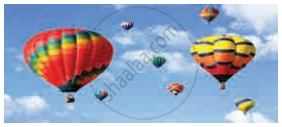
Identify the gas laws from the following diagram.
| Diagram | Gas laws |
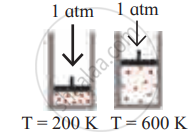 |
______________ |
Match the pairs of the following:
| Column ‘A’ | Column ‘B’ |
| a. Boyle’s law | i. at constant pressure and volume |
| b. Charles’ law | ii. at constant temperature |
| iii. at constant pressure |
Solve the following.
The volume of a given mass of a gas at 0°C is 2 dm3. Calculate the new volume of the gas at constant pressure when the temperature is increased by 10°C.
Solve the following.
A hot air balloon has a volume of 2800 m3 at 99°C. What is the volume if the air cools to 80°C?

Solve the following.
At 0°C, a gas occupies 22.4 liters. How much hot must be the gas in celsius and in kelvin to reach a volume of 25.0 liters?
The temperatures at which real gases obey the ideal gas laws over a wide range of pressure is called __________.
Use of hot air balloon in sports and meteorological observation is an application of
State Boyle's law.
Explain the following observation.
Aerated water bottles are kept under water during summer
Explain the following observation.
The type of an automobile is inflated to slightly lesser pressure in summer than in winter
Sulphur hexafluoride is a colourless, odourless gas; calculate the pressure exerted by 1.82 moles of the gas in a steel vessel of volume 5.43 dm3 at 69.5 °C, assuming ideal gas behaviour
For a given mass of an ideal gas, which of the following statements is CORRECT?
Isochor is the graph plotted between ______.
A gas occupies a volume of 4.2 dm3 at 101 kPa pressure. What volume will gas occupy if the pressure is increased to 235 kPa keeping the temperature constant?
If 2 moles of an ideal gas at 546 K has volume of 44.8 L, then what will be it's pressure? (R = 0.082)
10 g of gas at one atomospheric pressure is cooled from 273.15°C to 0°C keeping the volume constant. What is the final pressure?
If 300 mL of a gas at 26.85°C is cooled to 6.85°C at constant pressure. What will be the final volume of gas?
At what temperature, the volume of gas would become zero?
Identify the correct relationship between pressure (P), density (d), molar mass (M) and Temperature (T) for an ideal gas from the following.
