Advertisements
Advertisements
प्रश्न
Give reason for the following:
Gases exert pressure in all directions.
Gases unlike solids and liquids exert pressure in all directions.
Advertisements
उत्तर १
The gas particles have a very weak attractive force between them and move randomly ultimately exert pressure in all direction. Their molecules are bouncing all around the container because they are so small, then gravity has very little effect on them.
उत्तर २
Impact of gas molecules with high velocity causes pressure to be exerted on the walls.
संबंधित प्रश्न
State (i) the three variables for gas laws and (ii) SI units of these variables.
Convert the following temperature from degree Celcius to kelvin.
273° C
Convert the following pressure value into Pascals.
1 atmosphere
Identify the gas laws from the following diagram.
| Diagram | Gas laws |
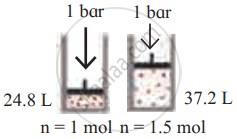 |
______________ |
Consider a sample of a gas in a cylinder with a movable piston.
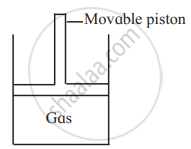
Show diagrammatically the changes in the position of the piston, if pressure is increased from 1.0 bar to 2.0 bar at a constant temperature.
Solve the following.
The volume of a given mass of a gas at 0°C is 2 dm3. Calculate the new volume of the gas at constant pressure when the temperature is decreased by 10°C.
State Boyle's law.
A certain sample of gas has a volume of 0.2 L at one atmosphere pressure and 273.15 K. What is the volume of gas at 273.15°C at same pressure?
A certain mass of a gas occupies a volume of 2 dm3 at STP. At what temperature the volume of gas becomes double, keeping the pressure constant?
If 2 moles of an ideal gas at 546 K has volume of 44.8 L, then what will be it's pressure? (R = 0.082)
